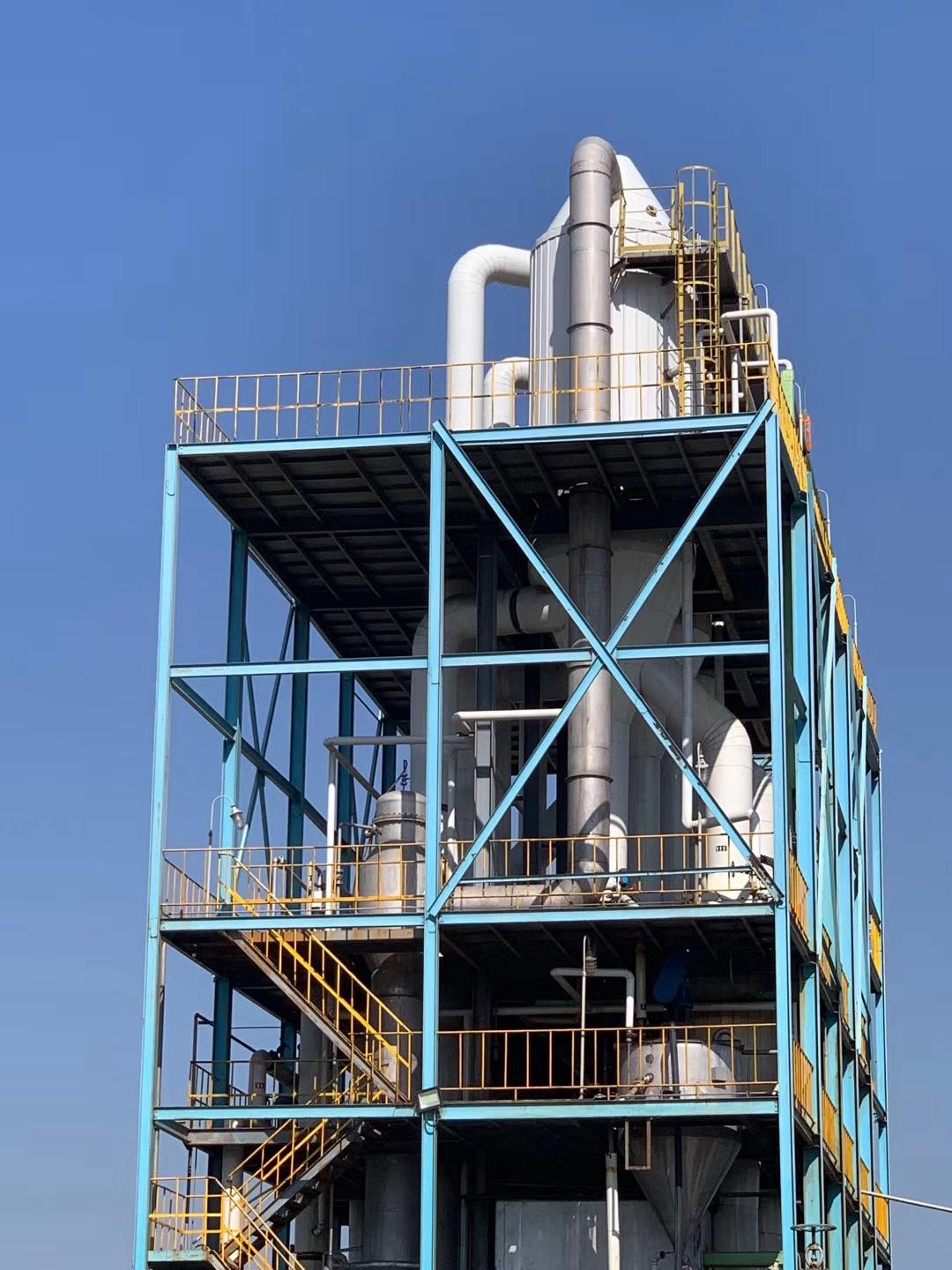
Overview
Crystallizers can be classified according to their material circulation methods. Among the most widely used industrial crystallizer technologies are:
• External circulation crystallizers (FC type)
• DTB (Draft Tube Baffle) crystallizers
Each type has unique structural characteristics and operating principles, making it suitable for different crystallization requirements, including product purity, crystal size distribution, production capacity, and process conditions.
The DTB (Draft Tube Baffle) Crystallizer is an advanced internal circulation crystallization system designed for applications requiring large, uniform, and high-purity crystals.
Through the combination of controlled internal circulation, optimized supersaturation management, and integrated crystal classification, DTB crystallizers provide excellent control over crystal growth and particle size distribution. They are widely applied in food, pharmaceutical, fertilizer, and fine chemical industries.
Structure and Working Principle
Main Components
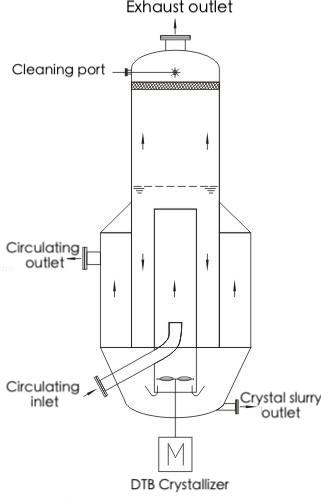
A typical DTB crystallizer mainly consists of the following components:
1. Draft Tube
The draft tube is centrally installed inside the crystallization chamber and serves as the main circulation channel.
A slow-speed axial impeller generates an upward flow inside the draft tube, creating a continuous internal circulation loop between the draft tube and the surrounding annular zone.
The draft tube provides:
• Uniform suspension of crystals;
• Improved mixing efficiency;
• Controlled crystal growth conditions;
• Reduced localized supersaturation.
2. Annular Baffle Zone
The annular baffle is installed around the outside of the draft tube and creates a relatively calm settling zone.
Its main functions include:
• Allowing larger crystals to settle;
• Separating crystals according to size and settling velocity;
• Preventing excessive circulation of product-size crystals;
• Returning smaller crystals and fines into the circulation zone for further growth.
This integrated classification mechanism enables the production of crystals with a narrower particle size distribution.
3. Vacuum Evaporation or Cooling System
Supersaturation, which is the driving force for crystallization, is generated through either:
• Evaporative crystallization under vacuum conditions; or
• Cooling crystallization through controlled temperature reduction.
The controlled formation of supersaturation promotes crystal growth while minimizing unwanted secondary nucleation.
4. Elutriation Column
The elutriation column is installed at the bottom of the crystallizer and provides hydraulic classification of crystals.
Its functions include:
• Separating product-size crystals from undersized particles;
• Returning fine crystals back into the crystallization zone;
• Improving final product quality and uniformity.
Working Cycle
The typical operating process of a DTB crystallizer is as follows:
Step 1: Feed Introduction
A thermally saturated feed solution is continuously introduced into the lower section of the crystallizer circulation system.
Step 2: Mixing and Heating
The incoming feed mixes with circulating mother liquor containing suspended fine crystals.
The mixture passes through a heater where the required temperature adjustment is achieved.
Step 3: Internal Circulation
The heated solution enters the bottom of the draft tube and is circulated upward by a low-speed axial-flow impeller.
This internal circulation ensures uniform crystal suspension and stable operating conditions.
Step 4: Supersaturation Generation and Crystal Growth
As the solution reaches the upper section of the crystallizer, supersaturation is generated through evaporation or cooling.
The supersaturated solution deposits dissolved materials onto suspended seed crystals, allowing crystal growth to occur.
Step 5: Crystal Classification
As crystals grow:
• Larger crystals move into the annular settling zone outside the baffle;
• Smaller crystals and fines remain suspended and return to the circulation loop for further growth or dissolution.
This classification mechanism improves crystal size distribution and reduces the formation of excessive fines.
Step 6: Product Discharge
The crystal slurry collected at the bottom enters the elutriation column.
Through hydraulic classification:
• Undersized crystals are returned to the crystallization zone;
• Qualified product crystals are discharged for downstream separation and processing.
Operational Features and Advantages
1. Production of Large and Uniform Crystals
The DTB crystallizer provides excellent control of supersaturation and crystal growth conditions.
Typical crystal sizes can reach approximately:
600–1200 μm
depending on product characteristics and operating parameters.
The larger crystal size provides advantages such as:
• Improved filtration performance;
• Reduced moisture content after separation;
• Better product handling characteristics.
2. Integrated Crystal Classification
The combination of:
• Draft tube circulation;
• Annular settling zone;
• Elutriation column;
provides effective particle classification inside the crystallizer.
This helps to:
• Reduce fine crystal content;
• Improve crystal purity;
• Achieve narrower particle size distribution.
3. Continuous Operation with Low Scaling Risk
Compared with conventional crystallizers, DTB crystallizers provide:
• Gentle circulation conditions;
• Reduced crystal collision and breakage;
• Stable long-term operation;
• Lower scaling tendency on heat transfer surfaces.
These characteristics make them suitable for continuous industrial production.
Typical Applications
Due to their ability to produce large, uniform, and high-quality crystals, DTB crystallizers are widely used in industries where crystal size and purity are critical.
Food Industry
Typical applications include:
• Sucrose crystallization;
• Sugar refining processes;
• Sweetener production.
Pharmaceutical Industry
Applications include:
• Antibiotic crystallization;
• Active pharmaceutical ingredient (API) purification;
• Specialty chemical crystallization.
Chemical and Fertilizer Industry
Typical products include:
• Potassium nitrate (KNO₃);
• Ammonium sulfate ((NH₄)₂SO₄);
• Citric acid;
• Other high-value inorganic and organic crystals.
Conclusion
The DTB (Draft Tube Baffle) Crystallizer is a high-performance crystallization technology designed for processes requiring precise control of crystal size distribution, purity, and product quality.
Through its unique internal circulation structure and integrated classification system, the DTB crystallizer provides excellent crystal growth conditions while reducing fines generation and improving downstream separation performance.
With these advantages, DTB crystallizers have become a preferred solution for demanding crystallization applications in food, pharmaceutical, and chemical industries.
Get In Touch With US
Enchem is here to listen to your needs and provide sustainable solutions. Contact us to discover more.