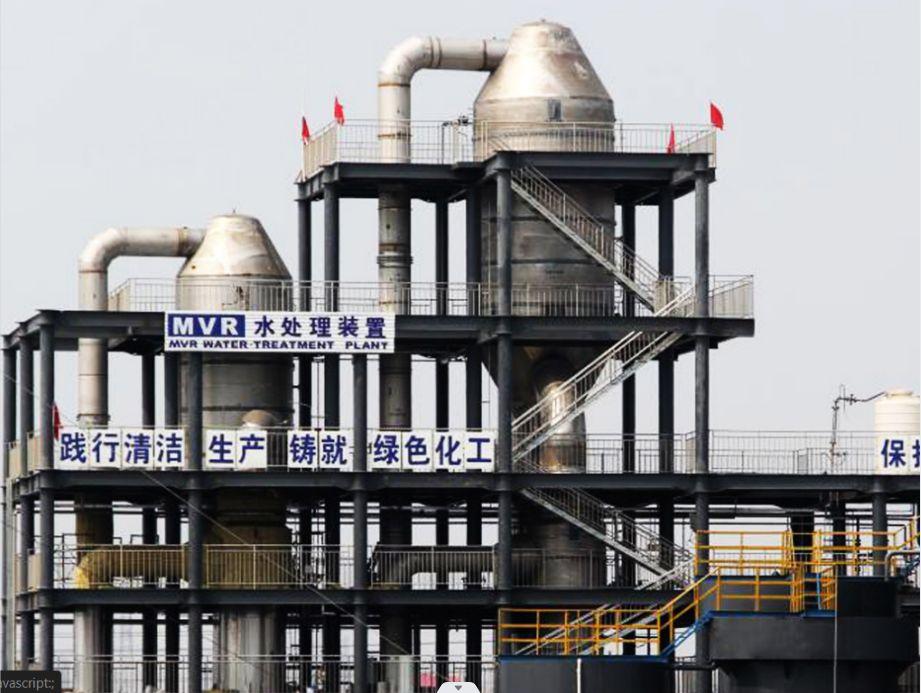
Landfill leachate is one of the more challenging wastewater streams to treat due to its complex and variable composition. It may contain high concentrations of dissolved salts, ammonia nitrogen, refractory organic compounds, suspended solids, and other contaminants.
Membrane technologies such as reverse osmosis (RO) and disc tube reverse osmosis (DTRO) are widely used in landfill leachate treatment. These processes can produce a relatively clean permeate stream for discharge or reuse. However, they also generate a concentrated reject stream containing most of the salts and contaminants retained by the membranes.
As a result, the treatment and disposal of RO or DTRO concentrate becomes an important part of the overall landfill leachate management process.
Why Does RO Concentrate Require Further Treatment?
Reverse osmosis is a separation process. It transfers much of the water into the permeate stream while retaining salts and many other contaminants in the concentrate.
Although this can significantly improve water recovery, the contaminants themselves are not eliminated. Instead, dissolved salts, refractory organic compounds, ammonia and other retained substances become concentrated in a smaller liquid volume.
In some landfill facilities, the RO concentrate is recirculated back to the landfill body. While this can reduce immediate liquid discharge, continuous recirculation may result in the gradual accumulation of salts and difficult-to-degrade contaminants within the leachate circulation system.
For facilities seeking higher overall water recovery, lower concentrate recirculation, or reduced liquid waste disposal, further treatment of the RO concentrate may therefore be required.
MVR Evaporation for Further Concentration and Water Recovery
Mechanical Vapor Recompression (MVR) evaporation can be installed downstream of the RO or DTRO system to further concentrate the membrane reject and recover additional water.
A typical process route can be represented as:
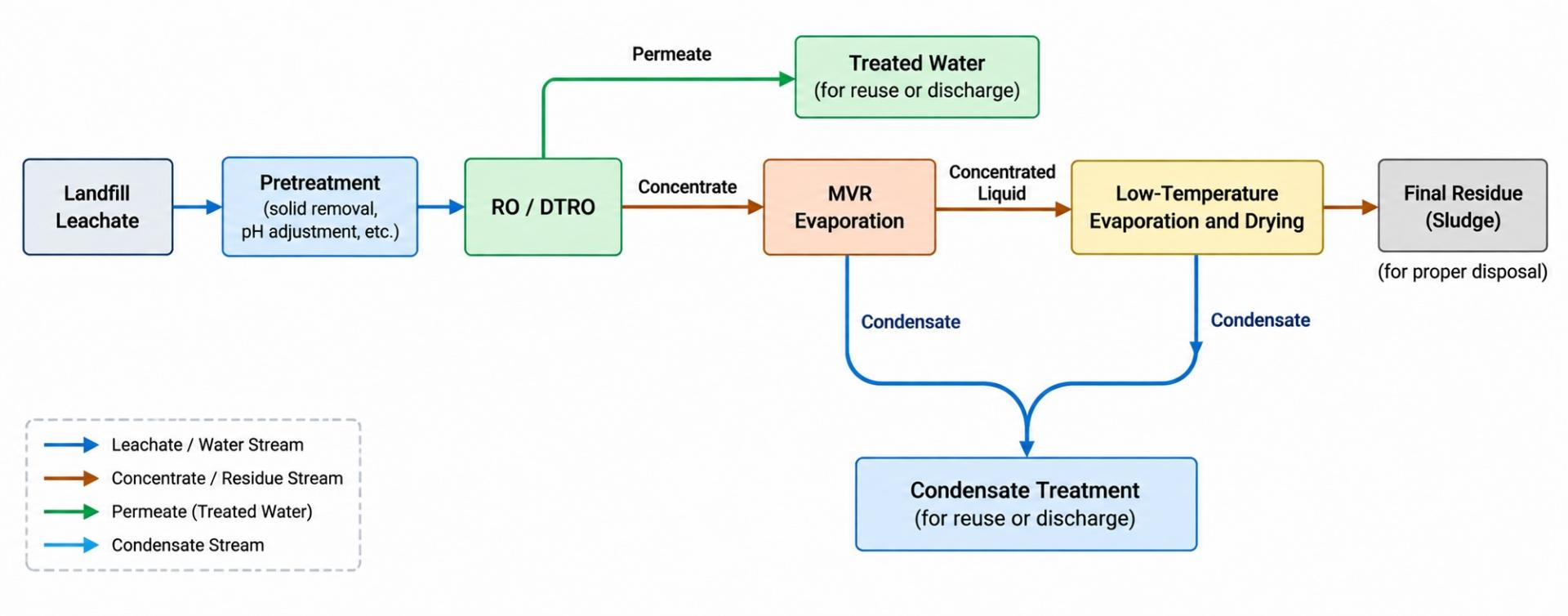
Landfill Leachate → Pretreatment → RO/DTRO → RO Concentrate → MVR Evaporation
In the MVR evaporator, water is evaporated from the concentrate under controlled operating conditions.
The generated secondary vapor is compressed by a vapor compressor. As the vapor pressure increases, its saturation temperature also increases, allowing the compressed vapor to be reused as the heating source for the evaporation process.
By recovering and reusing the energy contained in the secondary vapor, MVR evaporation can substantially reduce external steam consumption compared with conventional steam-driven evaporation systems.
For landfill leachate concentrate treatment, the main functions of the MVR system are therefore:
• Further recovery of water from the membrane concentrate;
• Reduction of the liquid concentrate volume;
• Concentration of non-volatile salts and contaminants into a smaller stream; and
• Reduction of the amount of liquid requiring recirculation, further treatment, or disposal.
Optional Downstream Treatment of MVR Concentrate
After MVR evaporation, different downstream treatment routes can be selected depending on the required degree of volume reduction and the final disposal strategy.
Direct Disposal of Concentrated Liquid
Where the concentrated liquid can be accepted by an appropriate downstream treatment or disposal facility, the MVR concentrate may be discharged directly.
In this configuration, the primary purpose of the MVR system is to recover water and significantly reduce the volume of liquid waste requiring further handling.
Further Volume Reduction by Low-Temperature Evaporation and Drying
Where greater volume reduction is required, the MVR concentrate can be further processed in a low-temperature evaporation and drying unit.
Because most of the water has already been removed by the MVR system, the downstream unit handles a much smaller flow rate.
Under vacuum conditions, additional water is evaporated at a relatively low operating temperature, allowing the moisture content and volume of the final waste to be further reduced.
A typical process route may therefore be:
RO/DTRO Concentrate → MVR Evaporation → Low-Temperature Evaporation and Drying → Concentrated Residue/sludge
In this way, the MVR evaporator performs the main bulk water removal with relatively high energy efficiency, while the low-temperature evaporation and drying unit is used to treat the much smaller concentrate stream where further waste-volume reduction is required.
MVR Evaporation as Part of an Integrated Treatment System
MVR evaporation should be considered as part of the complete landfill leachate concentrate management system rather than as an isolated piece of equipment.
A complete process may include:
Landfill Leachate → Pretreatment → RO/DTRO → MVR Evaporation → Optional Low-temperature Evaporation and Drying
At the same time, the recovered condensate may be reused directly or sent for further treatment depending on its quality. Since volatile compounds such as ammonia and certain organic substances may transfer into the condensate during evaporation, condensate quality should also be considered when determining the overall treatment route.
The overall process therefore needs to consider three important outputs:
Recovered water, concentrated residue, and contaminants transferred into the condensate.
The treatment or disposal route for each of these streams should be clearly defined before the final evaporation system is designed.
Conclusion
RO and DTRO membrane systems can recover a significant proportion of water from landfill leachate, but they inevitably generate a concentrated reject stream that requires appropriate management.
MVR evaporation provides an effective method for further concentrating this reject stream, recovering additional water, and reducing the volume of liquid requiring recirculation or disposal.
Depending on the project objectives, the MVR concentrate may be disposed of directly or further treated by low-temperature evaporation and drying system to achieve greater volume reduction.
For this reason, successful landfill leachate concentrate treatment requires more than simply selecting an evaporator. The complete system should be designed around the actual wastewater composition, required water recovery, condensate destination and final residue disposal strategy.
When these factors are considered together, MVR evaporation can become an effective component of an integrated approach to landfill leachate concentrate reduction and water recovery.
Contact US
Enchem is here to listen to your needs and provide sustainable solutions. Contact us to discover more.