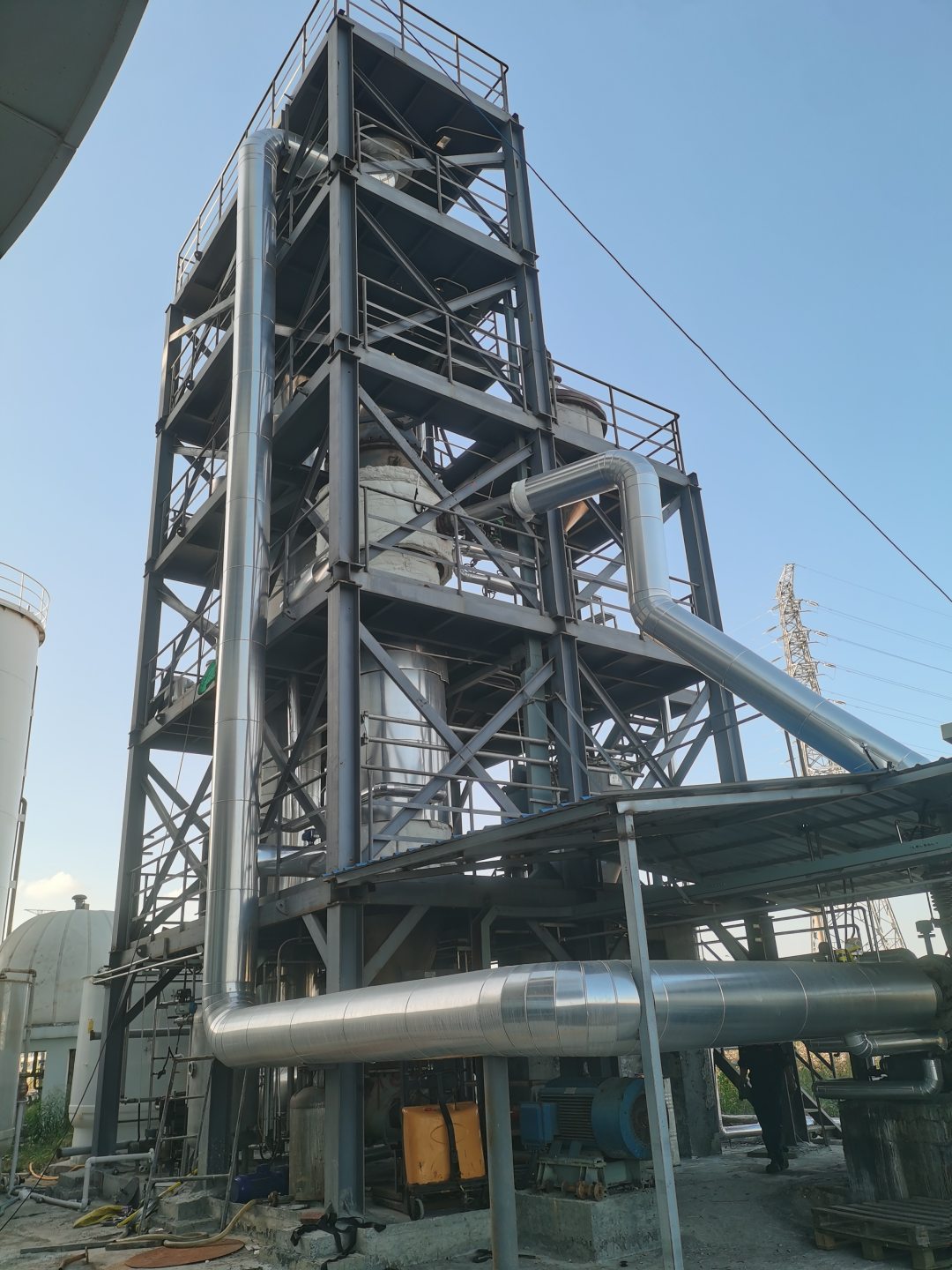
Mechanical Vapor Recompression (MVR) evaporators are widely used for the concentration and crystallization of high-salinity wastewater because of their high energy efficiency and low fresh steam consumption.
However, when evaluating an MVR evaporation and crystallization system, customers often ask:
If the MVR system evaporates water and crystallizes salts, why is there still a mother liquor purge? Why can’t all the mother liquor simply be recycled back into the system?
The fundamental reason is simple: some dissolved components cannot leave the system through either the condensate or the crystallized salts. Without a controlled purge, these components will continuously accumulate in the circulating mother liquor.
As their concentrations increase, they can cause higher viscosity, increased boiling point elevation (BPE), scaling, deterioration of heat transfer, poor crystallization behavior, and eventually unstable MVR operation.
Therefore:
Mother liquor purge is fundamentally a mass-balance requirement, not an indication of insufficient evaporation capacity.
A properly designed purge helps maintain the circulating solution within a stable operating range and ensures reliable long-term operation of the MVR evaporation and crystallization system.
1. What Is Mother Liquor?
In an MVR evaporation and crystallization system, water is continuously evaporated from the feed solution.
As water is removed, the concentration of dissolved salts increases. When certain salts reach supersaturation, they begin to crystallize.
The resulting crystal slurry is normally sent to a centrifuge or other solid-liquid separation equipment. After the crystals are separated, the remaining concentrated liquid is called the mother liquor.
A typical process can be simplified as:
Wastewater → MVR Evaporation → Crystallization → Centrifuge → Salt Crystals + Mother Liquor
Part of the mother liquor is normally recycled back into the evaporation and crystallization system to improve salt recovery.
However, in many industrial wastewater applications, recycling 100% of the mother liquor indefinitely is neither practical nor desirable.
A small portion is therefore removed as a controlled mother liquor purge.
2. What Happens If All Mother Liquor Is Recycled?
If the mother liquor is completely recycled without any purge, non-crystallizing and highly soluble components can gradually accumulate.
This can significantly change the physical and chemical properties of the circulating solution.
Increasing Viscosity
As dissolved solids accumulate, the mother liquor may become increasingly viscous.
Higher viscosity can result in:
• Reduced circulation performance
• Lower heat-transfer coefficients
• Increased pumping requirements
• Poor crystal growth
• Difficult solid-liquid separation
• Increased risk of pipe blockage
For a forced-circulation MVR evaporator, maintaining adequate circulation velocity is particularly important. Excessive viscosity can therefore directly affect evaporator performance.
Increasing Boiling Point Elevation
A concentrated salt solution does not boil at the same temperature as pure water under the same pressure.
The difference is known as Boiling Point Elevation (BPE).
As the dissolved salt concentration increases, BPE generally increases.
This is especially important in an MVR system because the compressor provides only a limited temperature increase to the secondary vapor.
The simplified heat-transfer driving force can be considered as:
Effective ΔT ≈ Compressed Vapor Temperature − Solution Boiling Temperature
As BPE increases, the boiling temperature of the solution rises and the effective temperature difference available for heat transfer decreases.
This can result in:
• Reduced evaporation capacity
• Larger required heat-transfer area
• Higher compressor pressure ratio
• Increased compressor power consumption
• Reduced energy efficiency
• Less stable system operation
Therefore, uncontrolled accumulation in the mother liquor can eventually affect not only crystallization but also the fundamental thermal performance of the MVR system.
Increasing Scaling Risk
Scale-forming components may also accumulate in the circulating mother liquor.
Depending on the wastewater composition, problematic components can include calcium, magnesium, sulfate, carbonate, fluoride, silica, and mixed salts.
If their concentrations exceed certain limits, uncontrolled precipitation may occur on heat-transfer surfaces rather than as manageable crystals inside the crystallizer.
This can create a typical deterioration cycle:
Scaling → Lower Heat Transfer → Reduced Evaporation Capacity → Higher Energy Consumption → More Frequent CIP → Shorter Operating Cycles
A controlled mother liquor purge helps keep these components below problematic concentration levels.
3. Why Not Continue Evaporating Until Everything Is Dry?
This is another common question.
Technically, additional water can often be removed from the mother liquor. However, this does not necessarily mean that the main MVR evaporator should continue concentrating the solution until it becomes completely dry.
As the final mother liquor becomes increasingly concentrated:
Salt concentration ↑ Viscosity ↑ Boiling point elevation ↑ Scaling tendency ↑ Heat-transfer difficulty ↑ Operating risk ↑
The final portion of water can therefore be much more difficult and energy-intensive to remove than the majority of the water handled by the MVR evaporator.
At very high concentrations, additional problems may also appear:
• Salt deposition inside heat exchangers and pipelines
• Poor circulation
• Formation of fine or sticky crystals
• Reduced centrifuge separation efficiency
• Co-crystallization of unwanted salts
• Lower product purity
• Frequent cleaning requirements
• Unstable automatic operation
This leads to an important engineering principle:
Maximum concentration is not necessarily the optimum operating concentration.
The optimum concentration should be selected based on energy consumption, salt recovery, product quality, scaling tendency, equipment reliability, and long-term operating stability.
4. How Is the Mother Liquor Purge Rate Determined?
There is no universal mother liquor purge percentage applicable to every MVR evaporator.
The appropriate purge rate depends on:
• Feed composition and TDS
• Individual salt concentrations
• Salt solubility and crystallization behavior
• Non-crystallizing impurities
• Mother liquor viscosity and BPE
• Scaling tendency
• Required salt recovery and product purity
For complex mixed-salt wastewater, laboratory evaporation and crystallization tests are often recommended to determine the practical concentration limit and appropriate purge rate.
5. Mother Liquor Purge Is Part of Stable MVR Design
When evaluating an MVR evaporation and crystallization system, the objective should not simply be:
“How can we eliminate mother liquor purge?”
A more appropriate engineering question is:
“What mother liquor concentration and purge rate will achieve high water and salt recovery while maintaining stable and energy-efficient operation?”
A properly controlled mother liquor purge can help:
• Prevent accumulation of non-crystallizing impurities
• Maintain manageable viscosity
• Control boiling point elevation
• Reduce scaling risk
• Maintain heat-transfer efficiency
• Improve crystallization stability
• Maintain crystal quality
• Reduce cleaning frequency
• Improve long-term system reliability
Therefore, mother liquor purge should not automatically be considered a process loss or a defect in the MVR design.
In many high-salinity wastewater applications, it is an intentional and necessary part of a properly designed evaporation and crystallization process.
Conclusion
An MVR evaporator can efficiently recover water and crystallize salts, but industrial wastewater normally contains multiple salts and impurities with different solubilities and crystallization behaviors.
While the main crystallizable salts can be continuously removed as solids, some highly soluble salts and non-crystallizing impurities remain in the mother liquor.
If all mother liquor is continuously recycled without an outlet, these components will gradually accumulate. This can lead to increased viscosity, higher boiling point elevation, scaling, reduced heat-transfer efficiency, poor crystallization behavior, and unstable MVR operation.
A controlled mother liquor purge provides the necessary outlet for these accumulated components and keeps the circulating solution within a suitable operating range.
For ZLD applications, the engineering objective is therefore not necessarily to eliminate the purge from the main MVR evaporator.
A more practical approach is often:
Minimize Mother Liquor Purge → Maintain Stable MVR Operation → Treat the Small Purge Stream Separately → Achieve Overall ZLD
Ultimately, a well-designed MVR evaporation and crystallization system should balance water recovery, salt recovery, energy efficiency, product quality, and long-term operational stability rather than simply pursuing the maximum possible concentration.

Contact US
Enchem is here to listen to your needs and provide sustainable solutions. Contact us to discover more.