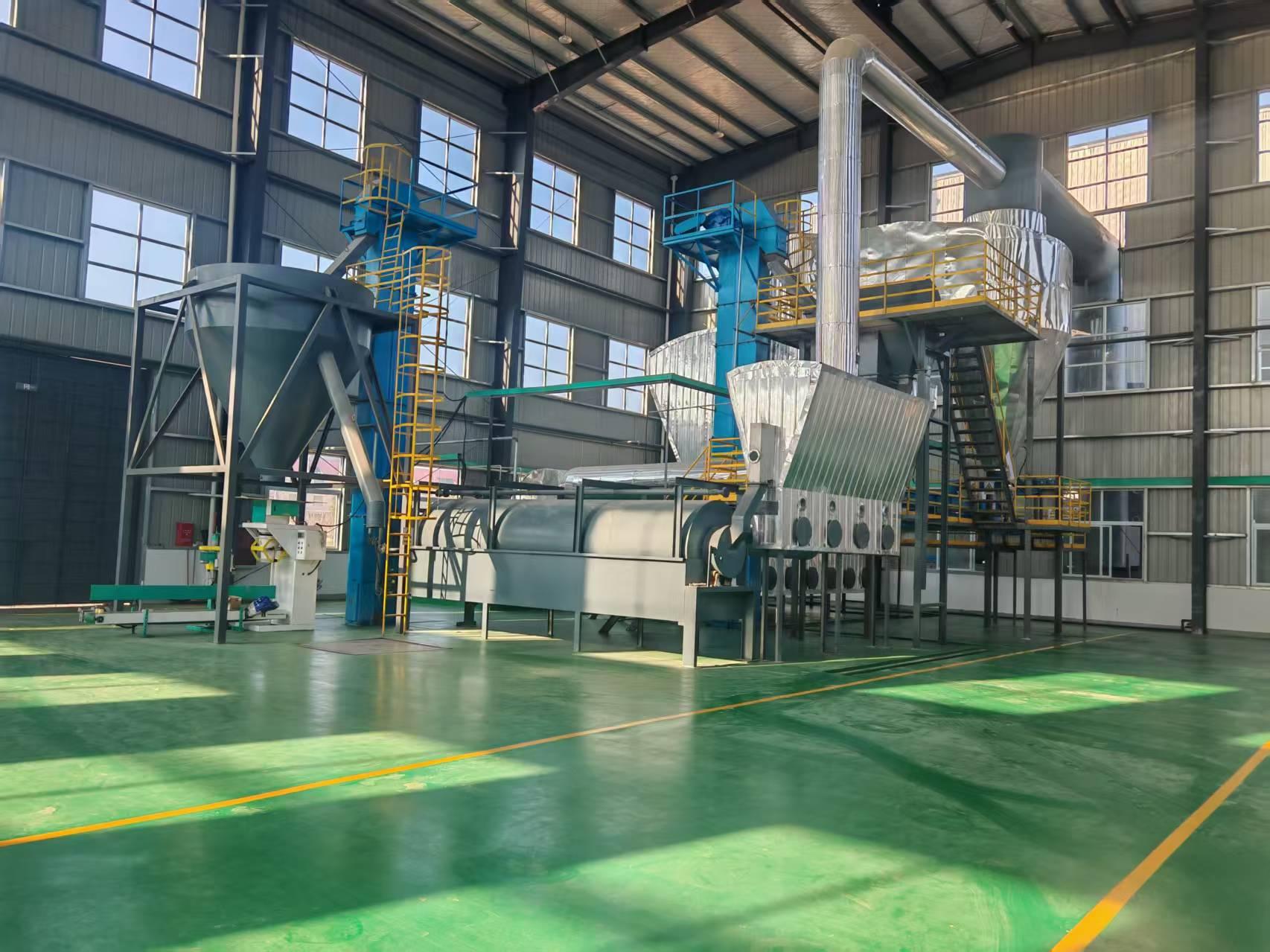
The production of high-quality anhydrous calcium chloride granules requires more than simply removing water from concentrated calcium chloride solution. The process must simultaneously achieve controlled particle growth, a stable particle size distribution, low final moisture content, efficient energy utilization, and reliable continuous operation.
Spray granulation fluidized bed technology combines atomization, granulation, and drying into a continuous process and is widely used for producing calcium chloride granules. However, granulation and final drying have different process objectives and do not necessarily require the same optimum operating conditions.
A two-stage fluidized bed drying system addresses this challenge by dividing the process into two functional stages:
• Primary spray granulation fluidized bed: optimized for atomization, particle growth, and preliminary drying.
• Secondary fluidized bed: optimized for controlled final drying of the size-qualified calcium chloride granules.
By separating these two functions, the operating conditions of each stage can be optimized independently, providing greater control over product quality, energy consumption, and overall system stability.
Understanding the Calcium Chloride Spray Granulation Process
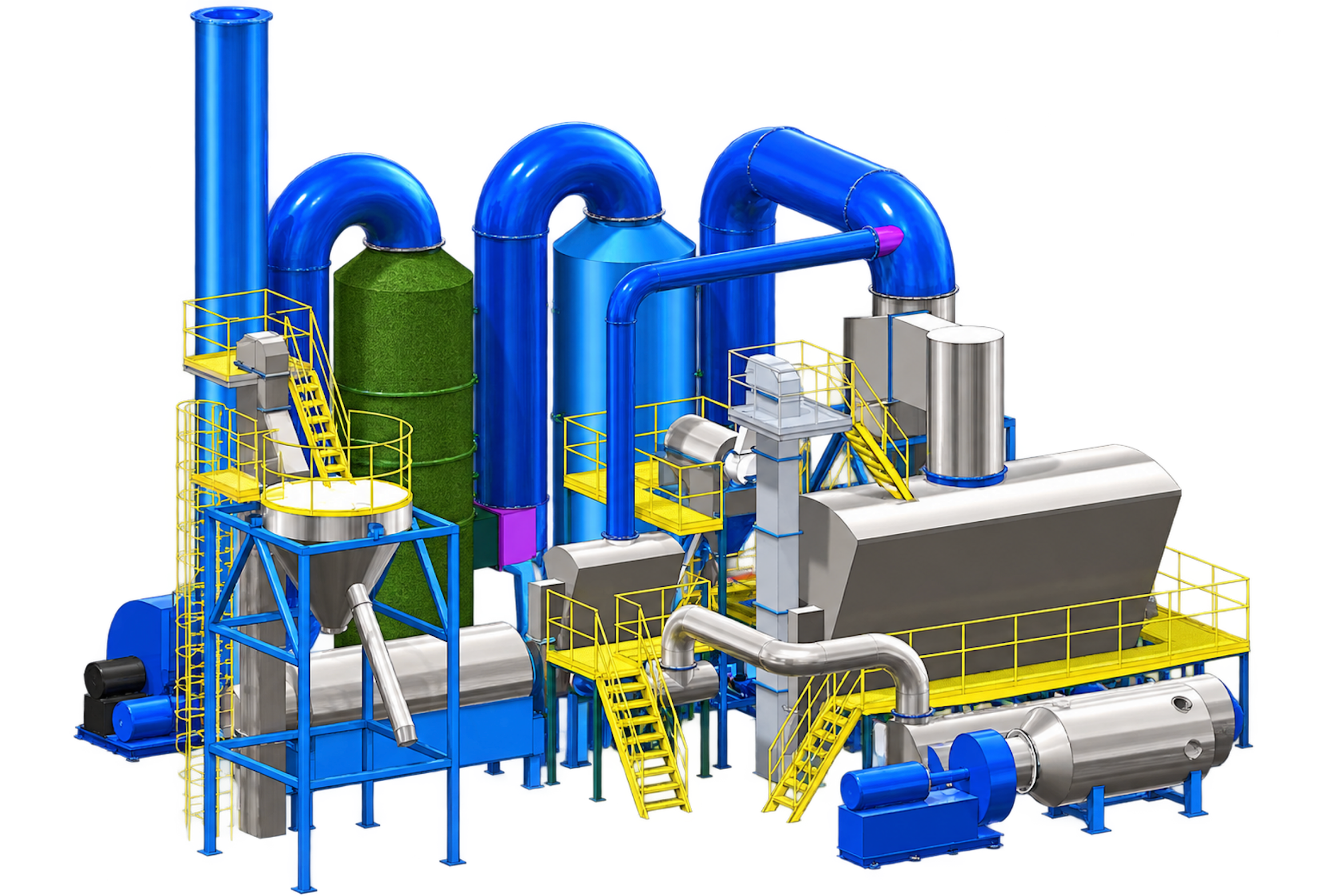
In a typical calcium chloride granulation process, concentrated calcium chloride solution is atomized into a fluidized bed containing seed particles and circulating granules.
The atomized droplets contact the fluidized particles and adhere to their surfaces. Water evaporates from the deposited liquid layer, leaving calcium chloride solids behind. Through repeated spraying, adhesion, drying, and circulation, the particles gradually grow to the required size.
The material discharged from the granulation stage is then screened.
Oversized particles can be crushed and returned to the granulation system, while undersized particles can be recycled as seed material. The size-qualified fraction continues to final drying, cooling, and product handling.
A simplified process can be represented as:
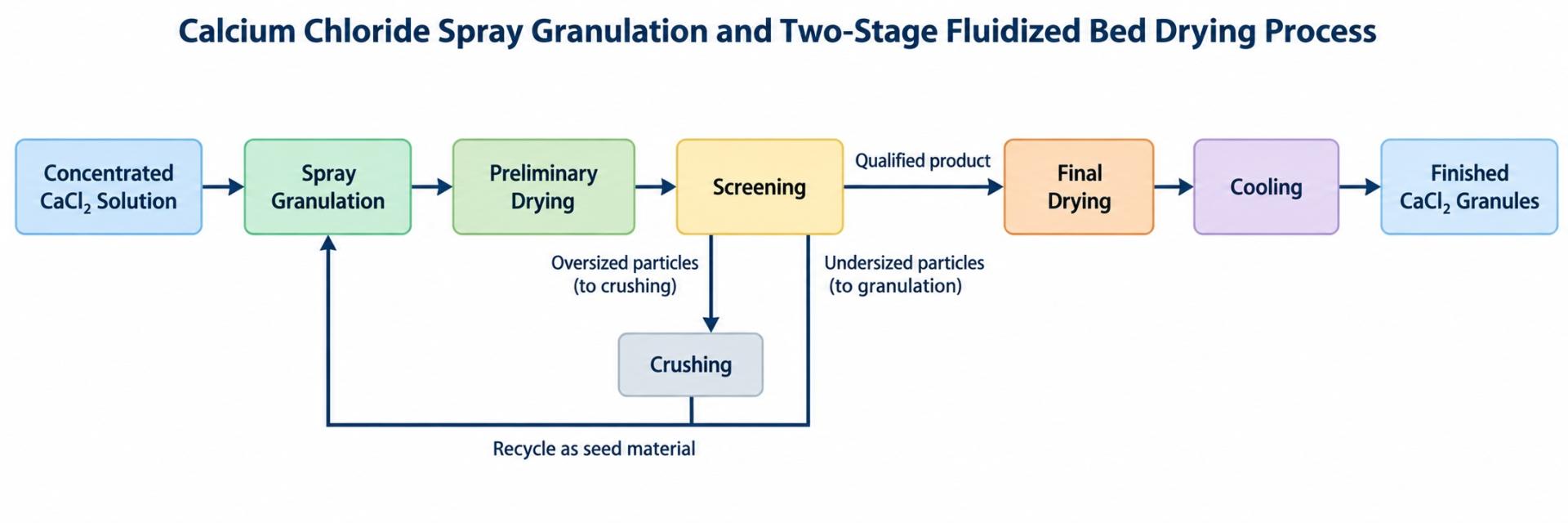
This continuous cycle allows calcium chloride solution to be converted directly into free-flowing granular product.
However, the performance of the process depends heavily on maintaining the correct balance between droplet adhesion, particle growth, heat transfer, moisture evaporation, and solids circulation.
Granulation and Final Drying Require Different Operating Conditions
One of the fundamental challenges in spray granulation is that efficient granule growth and intensive final drying do not always favor the same operating conditions.
During granulation, atomized calcium chloride droplets need sufficient opportunity to contact and adhere to circulating seed particles and growing granules.
If the droplets dry too rapidly, part of the sprayed material may form fine particles before effective adhesion occurs. This reduces granulation efficiency and increases dust generation.
If the material remains excessively wet, however, particles may become sticky and agglomerate excessively, potentially affecting fluidization and particle size distribution.
The primary granulation stage therefore requires a carefully controlled thermal and moisture environment.
Final drying has a different objective. Once the granules have reached the required particle size, the remaining moisture must be removed efficiently and consistently to achieve the required finished-product specification.
Attempting to optimize both objectives within a single fluidized bed can restrict the operating window of the system.
The two-stage design provides greater process flexibility by allowing each stage to perform a more clearly defined function.
Stage One: Optimizing Granule Formation
The primary spray granulation fluidized bed is the core particle-forming stage of the process.
Its main functions include:
• Atomization of concentrated calcium chloride solution.
• Contact between droplets and seed particles.
• Formation of a calcium chloride layer on the particle surface.
• Progressive particle growth.
• Preliminary moisture evaporation.
• Continuous circulation and classification of granules.
Rather than forcing this stage to independently achieve the final moisture specification, its operating conditions can be selected primarily according to the requirements of stable granulation.
This helps maintain an appropriate balance between droplet drying and droplet adhesion.
When properly controlled, the primary stage can promote:
• More effective particle growth.
• Reduced formation of unnecessary fines.
• More stable particle circulation.
• Better control of particle size distribution.
• More consistent granulation performance.
This is particularly important for continuous calcium chloride production, where stable particle growth directly affects product yield and downstream operating conditions.
Stage Two: Controlled Final Drying
After screening, the size-qualified calcium chloride granules enter the secondary fluidized bed for final drying.
At this stage, particle formation has essentially been completed. The main objective is therefore no longer granulation but controlled removal of the remaining moisture.
Because the secondary fluidized bed handles the qualified product stream, its operating parameters can be optimized specifically for final moisture control.
The final drying stage can provide:
• More consistent residual moisture.
• Improved moisture uniformity throughout the finished product.
• Better control before cooling and packaging.
• Reduced dependence of final product moisture on fluctuations in the primary granulation stage.
For calcium chloride, this final moisture control is particularly important because the product is highly hygroscopic. Stable final moisture contributes to more reliable cooling, storage, handling, and packaging.
Better Distribution of Thermal Duty
The two-stage arrangement also changes how thermal energy is distributed throughout the process.
In a single-stage configuration, the primary granulation fluidized bed must provide sufficient thermal capacity not only to evaporate water during granulation but also to ensure that the discharged product reaches the final required moisture content.
This can result in a relatively high drying intensity in the granulation zone.
In a two-stage system, the total drying requirement is distributed between the primary and secondary fluidized beds.
The first stage supplies the heat required for spray granulation and preliminary drying, while the second stage completes the remaining moisture removal from the qualified product.
This provides greater flexibility in selecting:
• Drying-air temperature.
• Airflow rate.
• Fluidized bed area.
• Residence time.
• Thermal load distribution.
• Exhaust-air conditions.
Rather than maximizing drying intensity in a single unit, the system can distribute the required duty according to the actual function of each stage.
Improving Energy Efficiency
Energy efficiency in a calcium chloride granulation system should be evaluated across the complete process rather than only at the individual dryer level.
The two-stage concept allows energy to be applied more selectively.
The primary fluidized bed can operate at conditions optimized for granulation rather than being driven solely by the final moisture requirement. The secondary fluidized bed then applies the necessary final drying duty specifically to the qualified product stream.
This approach can reduce unnecessary thermal intensity in the primary granulation stage and improve overall utilization of drying air.
Depending on the process design and operating conditions, potential benefits include:
• Lower heat demand in the primary granulation stage.
• More efficient use of drying air.
• Reduced unnecessary heating of circulating and recycled solids.
• Optimized airflow distribution between the two stages.
• Reduced fan and air-handling requirements.
• Lower overall energy consumption.
Actual energy consumption will depend on factors such as plant capacity, calcium chloride solution concentration, recycle ratio, final moisture specification, inlet air conditions, and heat source.
The main advantage of the two-stage concept is therefore not simply the addition of another dryer, but the ability to optimize where and how the drying energy is used.
Reducing Dust Generation
Dust formation is an important consideration in calcium chloride spray granulation.
If atomized droplets lose moisture too rapidly before contacting growing granules, part of the calcium chloride may form fine particles rather than contributing to particle growth.
These fines can increase the internal recycle load and also increase the burden on downstream gas-treatment equipment.
Because the two-stage process reduces the need to achieve all final drying within the primary granulation stage, the primary fluidized bed can operate within a more favorable granulation window.
This can help reduce excessive drying of atomized droplets and consequently reduce unnecessary fines generation.
Lower dust generation can provide benefits throughout the system:
• Reduced load on cyclone separators.
• Reduced load on wet scrubbers.
• Lower risk of material accumulation in ductwork.
• More stable system pressure.
• Reduced cleaning requirements.
• Improved operating environment.
Dust reduction therefore contributes not only to product yield but also to long-term system reliability.
Supporting Stable Continuous Operation
For an industrial calcium chloride plant, process stability is just as important as nominal production capacity.
A system that achieves high capacity only under a narrow operating window may experience frequent adjustments, cleaning, or shutdowns when feed conditions or production loads fluctuate.
Separating granulation and final drying gives operators additional flexibility to respond to these variations.
For example, changes in feed concentration, production rate, particle recycle, or ambient conditions may influence the heat and mass balance of the granulation stage. With an independent final drying stage, adjustments to final moisture control do not necessarily require significant changes to the primary granulation conditions.
This functional separation can contribute to:
• A wider and more flexible operating window.
• More stable final product specifications.
• Reduced sensitivity to short-term process fluctuations.
• Less frequent cleaning and maintenance.
• Longer continuous production periods.
• Improved overall plant availability.
For large-capacity calcium chloride plants, these improvements can have a significant impact on annual production and operating economics.
Product Quality and Process Efficiency Go Together
A common misconception in industrial drying is that higher drying temperature or greater drying intensity automatically produces better results.
For spray granulation, this is not necessarily the case.
The objective is not simply to remove as much moisture as possible in the shortest time. The process must first create granules with the required particle characteristics and then bring those granules to the required final moisture specification.
By assigning these objectives to separate process stages, the two-stage system provides more independent control over both particle formation and moisture removal.
This can contribute to a better overall balance between:
• Particle size distribution.
• Final product moisture.
• Product yield.
• Energy consumption.
• Dust generation.
• Equipment loading.
• Continuous operating stability.
Designing the System as an Integrated Process
The performance of a two-stage fluidized bed system depends on more than simply installing two dryers in series.
Successful process design requires consideration of the complete material and energy balance, including:
• Feed calcium chloride concentration.
• Required production capacity.
• Target product concentration and moisture.
• Required particle size distribution.
• Granulation recycle ratio.
• Atomization system.
• Drying-air temperature and volume.
• Fluidization velocity.
• Residence time.
• Screening and crushing arrangement.
• Exhaust-gas treatment.
• Product cooling requirements.
• Available fuel and utilities.
These parameters determine how the drying duty should be distributed between the primary and secondary stages.
The objective is to create an integrated system in which granulation, drying, classification, recycling, exhaust-gas treatment, and cooling operate as a coordinated process rather than as independent equipment sections.
Conclusion
Two-stage fluidized bed drying provides a different approach to calcium chloride spray granulation by recognizing that particle formation and final moisture removal are two distinct process objectives.
The primary spray granulation fluidized bed can focus on atomization, droplet adhesion, particle growth, and preliminary drying. The secondary fluidized bed can then focus on controlled final moisture removal from the size-qualified product.
This separation provides greater flexibility to optimize the operating conditions of each stage and can contribute to:
• More stable granule formation.
• More consistent particle quality.
• Better final moisture control.
• Reduced dust generation.
• More efficient distribution of drying energy.
• Lower exhaust-gas treatment load.
• Improved process stability.
• Longer continuous operating periods.
• Better overall plant performance.
For modern anhydrous calcium chloride granule production, the two-stage fluidized bed concept is therefore not simply a matter of adding additional drying equipment. It represents a process optimization strategy that separates granulation from final drying and allows both functions to operate under conditions better suited to their individual objectives.
When properly integrated with screening, material recycling, exhaust-gas treatment, and product cooling, this approach can provide a more efficient and reliable solution for continuous calcium chloride granule production.
Contact US
Feel free to contact us for customized solutions and competitive offers for calcium chloride system