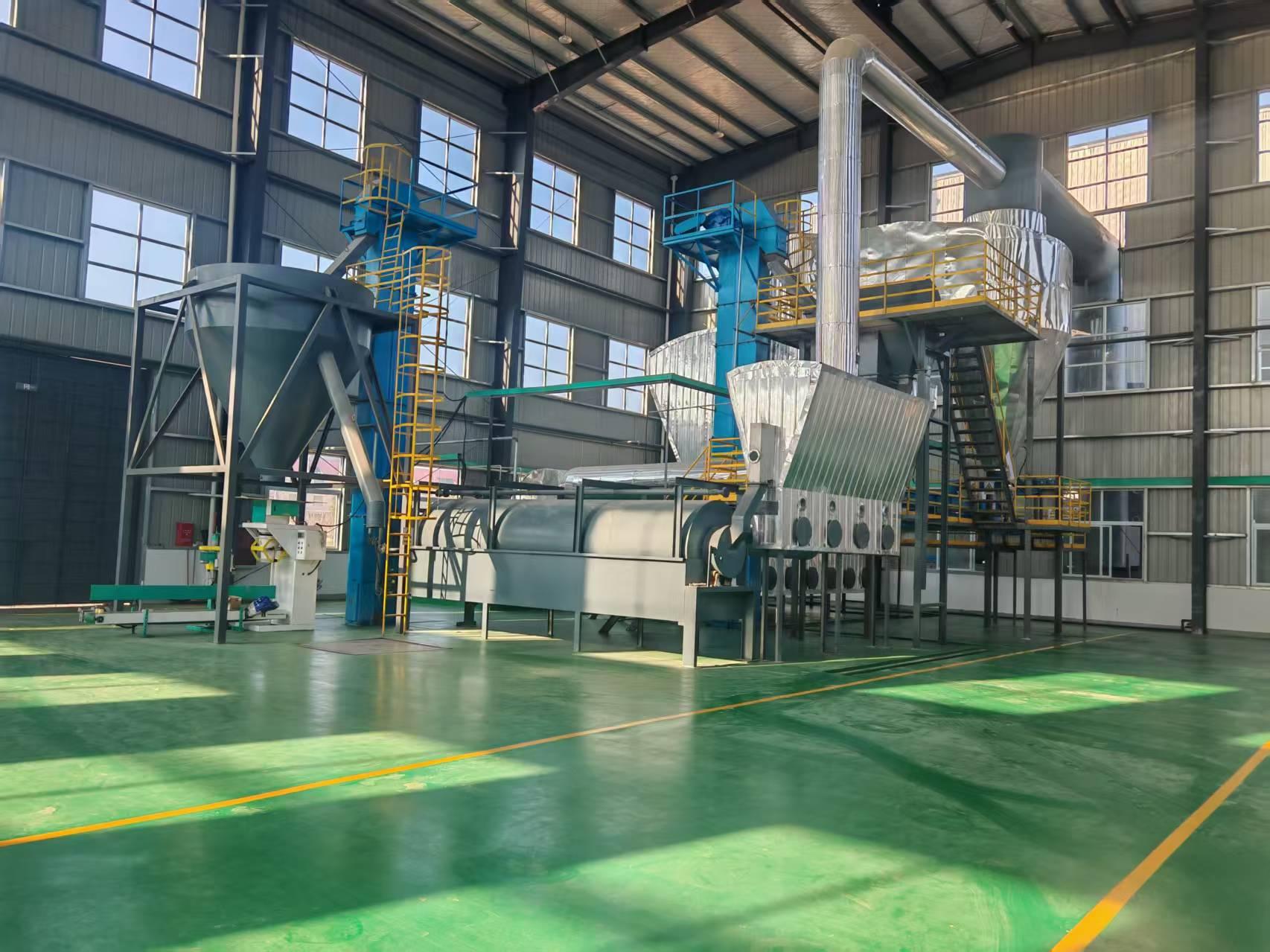
In the production of anhydrous calcium chloride granules, the spray granulation fluidized bed dryer plays a critical role in determining particle size, final moisture content, product quality, and overall production efficiency.
In a conventional single-stage calcium chloride spray granulation fluidized bed dryer, granulation and drying take place simultaneously within the same unit. This means that the operating conditions must satisfy two different process objectives: promoting effective granule growth while also providing sufficient drying capacity to achieve the required final product moisture.
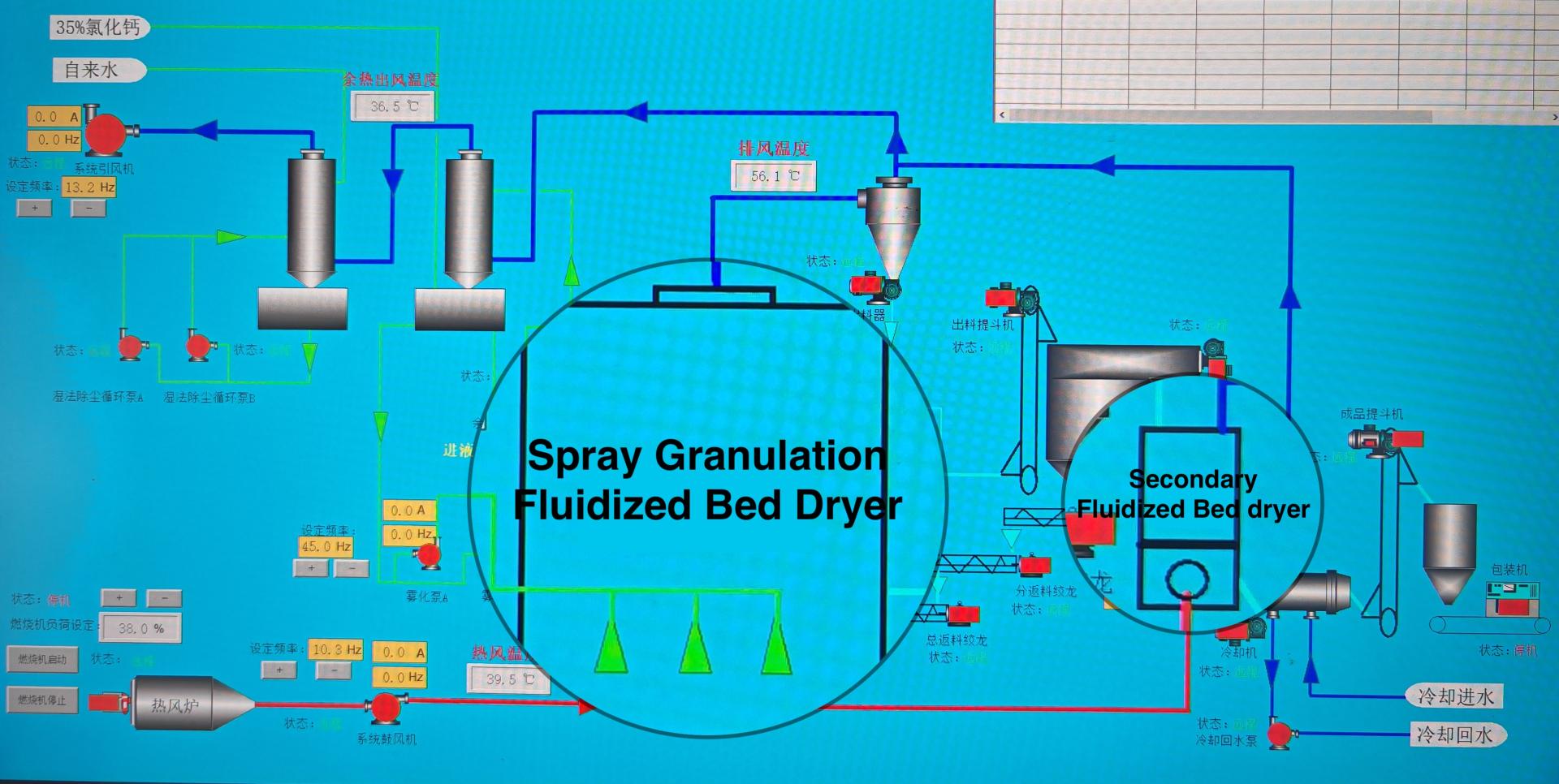
Our calcium chloride granulation process introduces a secondary fluidized bed downstream of the primary spray granulation fluidized bed dryer. Instead of requiring the primary granulator to complete both granulation and final drying, the secondary fluidized bed provides a dedicated final drying stage for the size-qualified product.
This separation of granulation and final drying provides several important advantages, including improved product consistency, reduced energy consumption, optimized equipment sizing, lower dust generation, and improved operational stability.
1. Improved Product Yield and Consistency
After leaving the primary spray granulation fluidized bed dryer, calcium chloride granules are screened according to the required particle size.
Oversized particles are crushed and recycled, while undersized particles are returned as seed material. Only the size-qualified product proceeds to the downstream process.
In a conventional single-stage system, this qualified product generally proceeds directly to cooling. Because there is no independent final drying stage, variations in residence time, particle size, production load, and fluidized bed conditions may result in fluctuations in final moisture content.
With the addition of a secondary fluidized bed:
• Only size-qualified granules enter the secondary dryer.
• Remaining moisture is removed under controlled drying conditions.
• Final moisture content can be controlled more precisely before cooling.
• Product moisture uniformity and consistency are improved.
• The risk of insufficiently dried product entering storage or packaging is reduced.
For calcium chloride, which is highly hygroscopic, reliable moisture control is particularly important for subsequent cooling, storage, handling, and packaging.
2. Reduced Drying Load on the Primary Fluidized Bed
In a conventional single-stage system, the primary spray granulation fluidized bed must provide sufficient drying capacity for the entire circulating material stream, including both qualified product and material that will subsequently be recycled.
Where the recycle ratio is relatively high, the internal solids circulation can be considerably greater than the actual finished-product output.
If the primary fluidized bed is required to independently achieve the final product moisture specification, it may require:
• A larger drying area and higher equipment capacity.
• Greater hot-air volume.
• Higher thermal duty.
• Larger fans and air-handling equipment.
• Greater exhaust-gas treatment capacity.
With a secondary fluidized bed, the primary dryer does not need to complete the entire final drying duty.
Instead, the primary unit can focus primarily on spray granulation, particle growth, and preliminary drying, while the secondary fluidized bed handles the remaining moisture removal from the qualified product.
This allows the drying duty to be distributed more efficiently between the two stages.
3. Reduced Energy Consumption
One of the key advantages of introducing a secondary fluidized bed is that intensive final drying can be applied specifically to the qualified product stream rather than to the entire circulating solids load.
In a conventional single-stage system, increasing the drying intensity of the primary fluidized bed affects not only the finished product but also the oversized and undersized material that will eventually be recycled.
With a secondary fluidized bed, final drying is concentrated on the material that will actually become finished product.
This can provide several energy-related benefits:
• Reduced thermal load on the primary granulator.
• More efficient utilization of drying air.
• Reduced unnecessary heating and drying of recycled material.
• Potentially lower fuel consumption.
• Reduced electrical demand for air handling.
The actual energy savings depend on the plant capacity, recycle ratio, feed concentration, required final moisture content, and operating conditions. However, separating final drying from granulation provides greater flexibility to optimize the overall energy balance of the system.
4. Lower Exhaust Gas Volume and Optimized Equipment Investment
Higher drying duty generally requires greater airflow, which in turn produces a larger volume of exhaust gas.
This affects not only the fluidized bed itself but also the downstream gas-treatment system, including cyclone separators, wet scrubbers, induced-draft fans, ducting, and other auxiliary equipment.
By transferring part of the final drying duty to the secondary fluidized bed, the primary granulation dryer can operate with a lower drying intensity and potentially lower airflow.
This can help:
• Reduce the exhaust-gas volume from the primary granulation stage.
• Reduce the load on cyclone separators and wet scrubbers.
• Lower fan power requirements.
• Optimize the size of the primary dryer and associated air-handling equipment.
• Improve the overall balance between equipment investment and operating cost.
Although the secondary fluidized bed represents an additional piece of equipment, the total system should be evaluated as an integrated granulation, drying, and exhaust-gas treatment process. Optimizing the primary dryer and its associated auxiliary equipment can provide important economic benefits for the overall plant.
5. Improved System Stability and Operational Reliability
Excessive dust generation can affect not only product yield but also the stability of the entire granulation and exhaust-gas treatment system.
Higher dust loading increases the burden on cyclone separators, scrubbers, ductwork, and induced-draft fans. Over time, this can contribute to material accumulation, fouling, increased system resistance, and more frequent cleaning requirements.
By allowing the primary fluidized bed to operate under more suitable granulation conditions, the secondary drying stage can help reduce unnecessary dust formation.
This contributes to:
• More stable fluidized bed operation.
• Reduced dust loading in the exhaust-gas system.
• Lower risk of fouling and material accumulation.
• Reduced cleaning and maintenance frequency.
• Longer continuous operating periods.
• Improved equipment availability and production efficiency.
For large-scale calcium chloride production plants, longer continuous operating periods can have a significant impact on overall production efficiency and operating economics.
6. Environmental Benefits
Improved energy efficiency and reduced exhaust-gas volume can also contribute to better environmental performance.
Potential benefits include:
• Lower overall energy consumption.
• Reduced fuel demand and associated carbon emissions.
• Lower exhaust-gas volume.
• Reduced particulate loading.
• Lower operating burden on dust collection and scrubbing systems.
These advantages support a more efficient and sustainable calcium chloride granulation process.
Conclusion
The addition of a secondary fluidized bed to a calcium chloride spray granulation fluidized bed dryer is more than simply adding another drying step. Its key advantage is the separation of granulation from final drying.
The primary fluidized bed can be operated under conditions better suited to atomization, droplet adhesion, and granule growth, while the secondary fluidized bed provides controlled final moisture removal for the size-qualified product.
Compared with relying on a single fluidized bed to perform both functions, this configuration can provide:
• More consistent final product moisture.
• Improved granulation performance.
• Reduced drying load on the primary fluidized bed.
• Lower energy consumption.
• Reduced dust generation.
• Lower exhaust-gas treatment load.
• Improved system stability.
• Longer continuous operating periods.
• Optimized overall equipment and operating costs.
For the production of high-quality anhydrous calcium chloride granules, the secondary fluidized bed therefore provides an effective way to improve product quality, energy efficiency, process reliability, and overall plant performance.
Contact US
Feel free to contact us for customized solutions and competitive offers for calcium chloride system