
Overview
In industrial crystallization processes, crystallizers are commonly classified according to their circulation mechanism and crystal growth mode. The most widely used types include:
• External circulation crystallizers
• DTB (Draft Tube Baffle) crystallizers, and
• OSLO crystallizers.
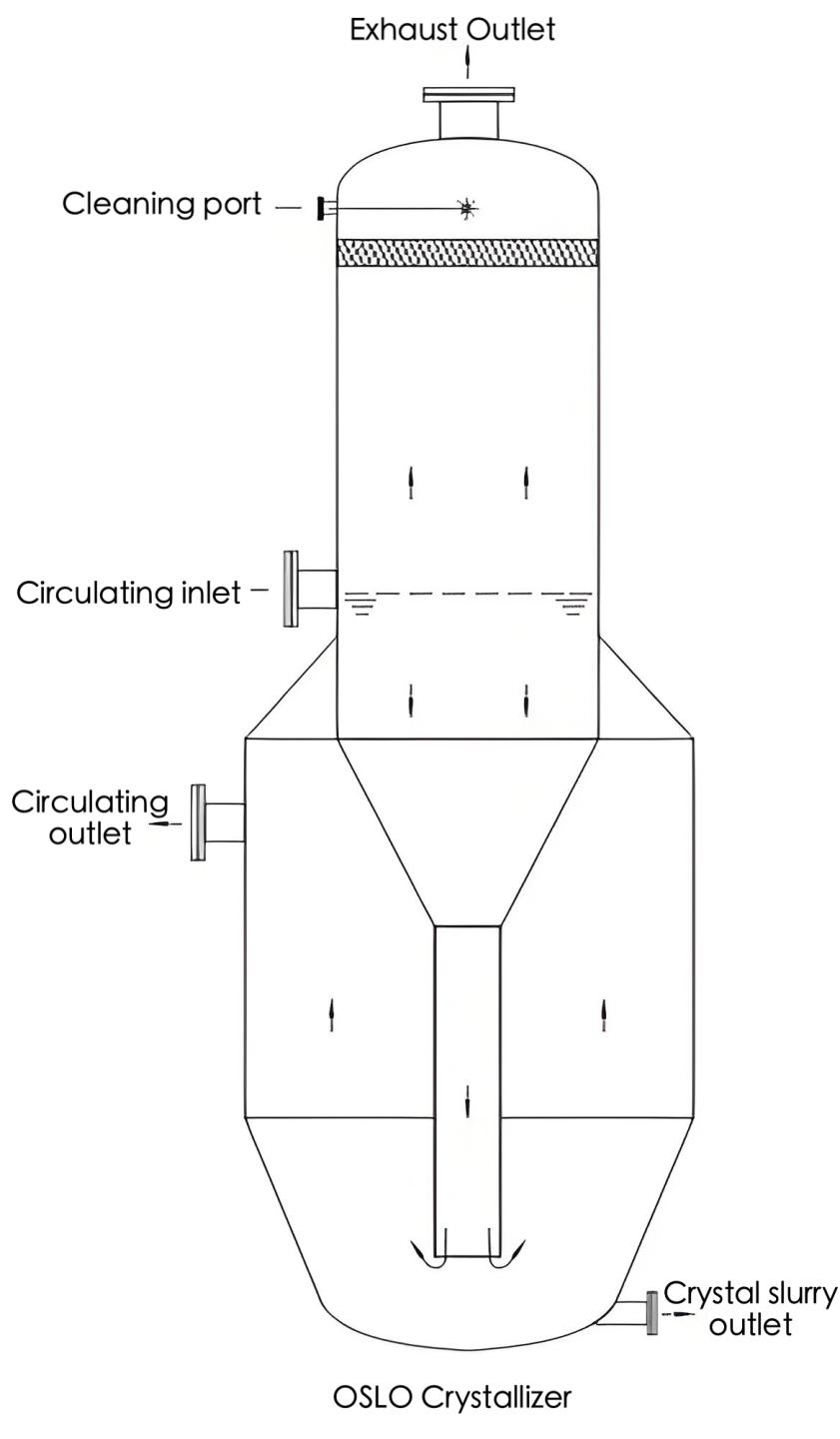
Among these technologies, the OSLO crystallizer, also known as a suspension bed crystallizer or Krystal crystallizer, is specifically designed for applications requiring large, spherical, and highly uniform crystals.
Unlike conventional slurry circulation crystallizers, the OSLO crystallizer operates with a fluidized crystal bed, where existing crystal particles are suspended and continuously grow under carefully controlled supersaturation conditions. This unique operating principle promotes controlled crystal growth, minimizes secondary nucleation, and produces high-quality crystals with narrow particle size distribution.
Main Components of an OSLO Crystallizer
An OSLO crystallizer typically consists of the following key sections:
1. Evaporation or Cooling Chamber
The evaporation or cooling chamber provides the required supersaturation conditions through either:
• Evaporation-driven concentration; or
• Cooling-induced crystallization.
The controlled generation of supersaturation provides the driving force for crystal growth.
2. Crystal Fluidized Bed
The fluidized crystal bed is the core component of the OSLO crystallizer.
Supersaturated mother liquor enters from the bottom of the vessel and flows upward through the suspended crystal bed. As the solution passes through the crystal particles, dissolved solute deposits onto existing crystal surfaces, allowing crystals to grow gradually and uniformly.
3. Circulation System
A circulation pump continuously recycles mother liquor through the heating or cooling section and back into the crystallization chamber.
The controlled circulation rate ensures:
• Stable crystal suspension;
• Uniform supersaturation distribution;
• Reduced risk of excessive nucleation.
Working Principle of OSLO Crystallizer
The operating cycle of an OSLO crystallizer can be summarized as follows:
1. Mother Liquor Circulation
The circulation pump withdraws relatively clear solution containing few or no crystals and transfers it to the heater or heat exchanger.
2. Generation of Supersaturation
Heating or cooling changes the solubility balance of the solution, increasing supersaturation and creating the driving force for crystallization.
3. Introduction into the Crystal Bed
The supersaturated solution enters through a central downpipe extending into the lower section of the fluidized crystal bed.
4. Controlled Crystal Growth
As the solution slowly rises through the crystal bed, supersaturation gradually decreases. Dissolved materials deposit onto existing crystal surfaces rather than forming excessive new nuclei.
5. Natural Crystal Classification
The OSLO design provides automatic crystal classification:
• Larger crystals settle toward the bottom of the bed;
• Smaller crystals remain in the upper section.
This classification mechanism allows continuous production of uniform, coarse crystals.
6. Product Withdrawal
Product crystals are continuously removed from the bottom of the crystallizer, resulting in consistent crystal size, excellent morphology, and improved downstream processing performance.
Key Operational Advantages of OSLO Crystallizer
1. Excellent Crystal Quality
The counter-current contact between supersaturated solution and suspended crystal particles enables:
• Uniform crystal growth;
• Large crystal size;
• Narrow particle size distribution;
• Improved product purity.
2. Reduced Secondary Nucleation
The controlled circulation and stable supersaturation profile help maintain operation within the metastable zone, reducing unwanted nucleation and improving crystal growth efficiency.
3. Flexible Process Control
The circulation rate can be adjusted according to process requirements, allowing optimization of:
• Crystal growth rate;
• Supersaturation level;
• Crystal size distribution.
Design Considerations and Limitations
While OSLO crystallizers provide excellent crystal quality, proper process design is essential.
Key considerations include:
• Maintaining supersaturation within an appropriate metastable range;
• Controlling fluidization velocity to ensure stable crystal suspension;
• Optimizing slurry concentration and circulation conditions.
Compared with slurry circulation crystallizers, OSLO crystallizers may have lower production capacity for the same vessel size due to limitations in fluidization velocity and crystal bed concentration.
Therefore, technology selection should consider both product quality requirements and production capacity targets.
Typical Applications of OSLO Crystallizers
OSLO crystallizers are particularly suitable for applications requiring large, high-purity, and uniform crystals, including:
• Potassium chloride (KCl) production
• Sodium sulfate (Na₂SO₄) crystallization
• Other inorganic salt crystallization processes
• Specialty chemical production requiring controlled crystal morphology
Conclusion
The OSLO crystallizer is an advanced crystallization technology designed for applications where crystal size, shape, and quality are critical. Through its unique fluidized crystal bed operation and controlled supersaturation management, it enables the continuous production of large, uniform, and high-purity crystals.
With advantages in crystal quality and process control, OSLO crystallizers remain a preferred solution for many chemical and salt production industries where downstream separation, drying, and product specifications require consistent crystal performance.
By combining crystallization process expertise with customized equipment design, we provide optimized OSLO crystallization solutions tailored to different materials, capacities, and product requirements.
Get In Touch With US
Enchem is here to listen to your needs and provide sustainable solutions. Contact us to discover more.