Abstract
Industrial crystallization is widely used in chemical, fertilizer, pharmaceutical, and wastewater treatment industries for the separation and purification of valuable products. Among various crystallization technologies, FC (Forced Circulation) crystallizers, DTB (Draft Tube Baffle) crystallizers, and Oslo crystallizers are three of the most commonly applied continuous evaporative crystallization systems.
Each crystallizer type has its own characteristics regarding crystal size, circulation method, equipment configuration, and operating flexibility. The selection of the appropriate crystallizer depends mainly on product requirements, crystal size expectations, material properties, production capacity, and process conditions.
This article provides a comparison of FC, DTB, and Oslo crystallizers to help engineers and project owners better understand their differences and select the most suitable crystallization technology.
FC Crystallizer – Reliable Solution for Large-Scale Evaporative Crystallization
1. Working Principle
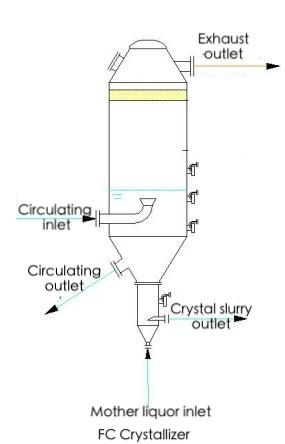
The FC (Forced Circulation) crystallizer, also known as an externally heated circulation evaporative crystallizer, is one of the most widely used industrial crystallization systems due to its simple structure and reliable operation.
The system mainly consists of:
• External heating chamber
• Evaporation crystallization chamber
• Horizontal forced circulation axial flow pump
• Upper and lower circulation pipelines
During operation, the circulation pump continuously transfers the solution through the external heater. After heating, the supersaturated solution enters the evaporation chamber under vacuum conditions, where solvent evaporation occurs and crystals are generated.
2. Characteristics of FC Crystallizer
The main advantages of FC crystallizers include:
• Simple equipment structure
• Easy operation and maintenance
• High adaptability to different materials
• Suitable for large evaporation capacities
• Typical crystal size: 0.15 – 0.3 mm
Due to the strong circulation and relatively short crystal residence time, FC crystallizers generally produce smaller crystals compared with DTB and Oslo crystallizers.
FC crystallizers are widely applied in:
• Sodium chloride crystallization
• Ammonium chloride crystallization
• Wastewater zero liquid discharge (ZLD)
• Fertilizer production
• Inorganic salt concentration processes
3. Key Design Considerations
Proper hydraulic design is important to ensure stable operation.
A typical design consideration is that the crystallization chamber should be installed sufficiently higher than the heating chamber:
Liquid level of crystallization chamber to upper tube sheet of heater: approximately 4–6 m
This arrangement helps to:
• Avoid boiling at the heat exchanger tube inlet
• Prevent crystal precipitation inside heat exchanger tubes
• Reduce the risk of tube blockage
The circulation pipeline design is also critical:
• Upper circulation pipe velocity: generally < 1 m/s
• Lower circulation pipe velocity: approximately 1.3–1.5 m/s
The larger diameter of the upper circulation pipe helps prevent unstable boiling caused by flashing when the heated solution enters the vacuum chamber.
DTB Crystallizer – Controlled Crystal Growth with Excellent Product Quality
1. Working Principle
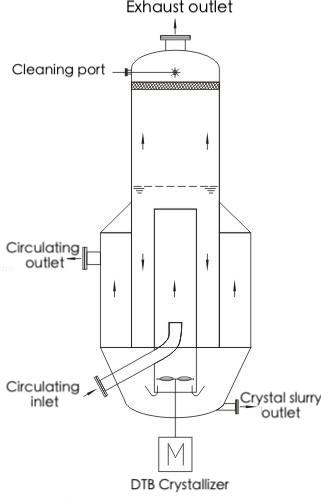
The DTB (Draft Tube Baffle) crystallizer is a modern continuous crystallization technology featuring a draft tube and internal baffle structure.
The system consists mainly of:
• Heating chamber (for evaporation crystallization)
• Evaporation crystallization chamber
• Vertical axial flow circulation pump
• Draft tube
• Crystallization zone
• Evaporation zone
• Mother liquor separation zone with baffle
DTB crystallizers can be operated through:
• Vacuum evaporation crystallization
• Vacuum flash cooling crystallization
The draft tube creates controlled internal circulation, allowing crystals to grow under relatively stable hydrodynamic conditions.
2. Crystal Characteristics
Compared with FC crystallizers, DTB crystallizers provide better crystal growth control and generally produce larger and more uniform crystals.
Typical crystal size: 0.2 – 1.2 mm
Main advantages:
• Larger crystal size
• Narrow particle size distribution
• Better crystal morphology
• Smooth crystal surface
• Adjustable crystal size within a certain range
The final crystal characteristics depend on:
• Material properties
• Supersaturation control
• Circulation rate
• Residence time
• Axial flow pump design
3. Key Design Considerations
The design of DTB crystallizers requires detailed consideration of crystal settling characteristics.
The crystallizer diameter is normally determined based on different settling zones:
• Evaporation zone
• Crystal growth zone
• Mother liquor separation zone
Typical design criteria:
| Area | Typical Velocity |
| Draft tube upward flow | ≤1.0 m/s |
| Evaporation zone settling velocity | ≤0.2 m/s |
| Crystal zone settling velocity | ≤0.1 m/s |
| Mother liquor zone settling velocity | ≤0.05 m/s |
The vertical axial flow pump is a key component of DTB crystallizers. It is characterized by:
• Large circulation capacity
• Low head
• Low rotational speed
• Large diameter impeller
The pump design directly influences crystal growth and particle size distribution.
Oslo Crystallizer – Technology for Producing Large Crystal Particles
1. Working Principle
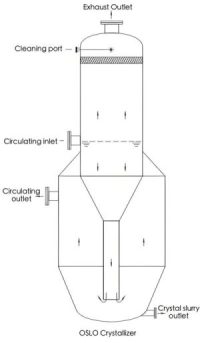
The Oslo crystallizer, also known as a growth-type crystallizer or fluidized bed crystallizer, was originally developed by F. Jeremiasson of Oslo Crystallizer Company and named after Oslo, Norway.
Unlike conventional crystallizers, the Oslo design separates crystal growth from nucleation. Crystals grow in a controlled fluidized bed zone, allowing longer residence time and producing significantly larger crystals.
The main components include:
• Heating chamber
• Condensate separator
• Evaporation crystallization chamber
• Horizontal axial flow circulation pump
• Circulation pipelines
The crystallization chamber mainly consists of:
• Circulation zone (fluidized bed zone)
• Evaporation zone
• Crystal growth zone
2. Crystal Characteristics
The main advantage of Oslo crystallizers is the production of very large crystals.
Typical crystal size:1.0~3.0 mm
Compared with FC and DTB crystallizers, Oslo crystallizers provide:
• Much larger crystal size
• Excellent crystal classification
• Long crystal growth time
• High-quality crystal morphology
The crystal growth time is typically: 6–10 hours or longer
The crystal growth chamber volume is normally designed according to: 6–10 times of feed flow volume (m³/h)
The required volume depends on:
• Crystal growth rate
• Product characteristics
• Target particle size
3. Typical Applications
Oslo crystallizers are suitable for applications requiring large crystal products, such as:
• Potassium chloride (KCl)
• Ammonium sulfate
• Specialty inorganic salts
• High-value crystalline products
Comparison Among FC, DTB, and Oslo Crystallizers
| Item | FC Crystallizer | DTB Crystallizer | Oslo Crystallizer |
| Main Principle | Forced circulation evaporation | Draft tube controlled circulation | Crystal growth in fluidized bed |
| Structure Complexity | Simple | Medium / Complex | Complex |
| Crystal Size | 0.15–0.3 mm | 0.2–1.2 mm | 1.0-3.0 mm |
| Crystal Growth Control | Moderate | Excellent | Excellent |
| Residence Time | Short | Medium | Long |
| Circulation Pump | Horizontal axial flow pump | Vertical axial flow pump | Horizontal axial flow pump |
| Operation | Easy | Moderate | More complex |
| Suitable For | Large evaporation capacity | Controlled crystal quality | Large crystal production |
How to Select the Suitable Crystallizer?
The selection of crystallizer type should be based on the final product requirements.
FC crystallizer is recommended when:
• Large evaporation capacity is required
• Simple operation is preferred
• Crystal size requirements are moderate
• Reliable continuous operation is important
DTB crystallizer is recommended when:
• Better crystal quality is required
• Crystal size needs to be controlled
• Narrow particle size distribution is important
• Product purity and morphology are critical
Oslo crystallizer is recommended when:
• Very large crystals are required
• Long crystal growth time is acceptable
• Crystal classification performance is important
Conclusion
FC, DTB, and Oslo crystallizers represent three important industrial crystallization technologies, each with unique advantages.
The FC crystallizer provides a simple and robust solution for large-scale evaporation crystallization.
The DTB crystallizer offers improved crystal growth control and better product quality through optimized circulation and classification.
The Oslo crystallizer is especially suitable for applications requiring very large crystal particles and excellent crystal growth performance.
A proper crystallizer selection requires comprehensive evaluation of:
• Product crystal size requirements
• Material characteristics
• Production capacity
• Energy consumption
• Operating conditions
• Investment considerations
With professional process design and engineering experience, the optimal crystallization technology can be selected to achieve stable operation, high product quality, and economic performance.
Get In Touch With US
Enchem is here to listen to your needs and provide sustainable solutions. Contact us to discover more.