Overview
Crystallizers can be classified according to their material circulation methods. Among the various crystallizer designs used in industrial applications, the three most common types are:
• External Circulation Crystallizers (FC Crystallizer)
• DTB (Draft Tube Baffle) Crystallizers
• OSLO Crystallizers.
Each crystallizer type features unique structural configurations and operating principles, making them suitable for different crystallization processes, product requirements, and operating conditions.
This article provides an overview of the major crystallizer types and introduces their design characteristics, working mechanisms, and typical applications. The first section focuses on the External Circulation Crystallizer (FC Type), one of the most widely applied crystallization technologies in chemical processing industries.
External Circulation Crystallizer (FC Type)
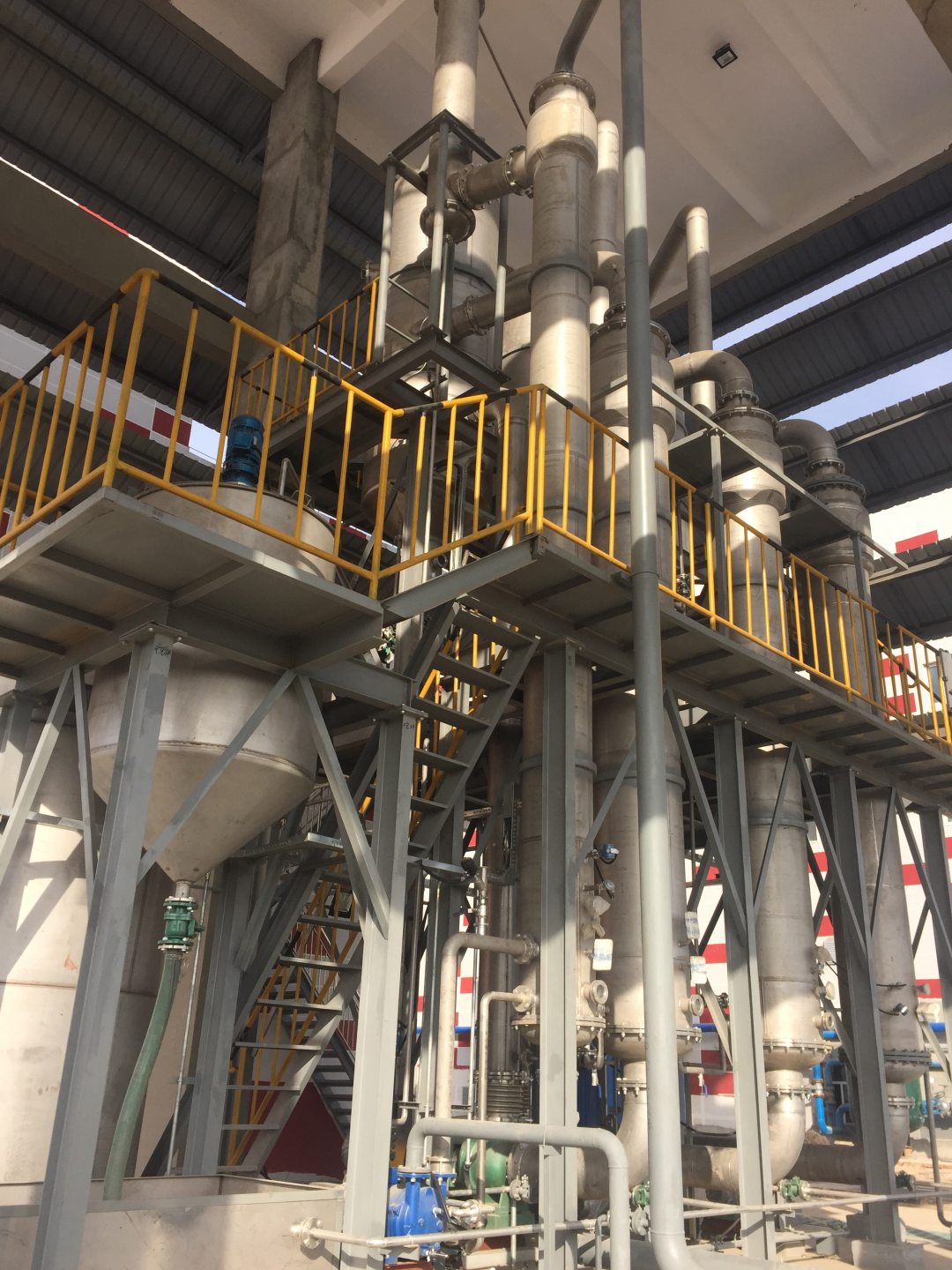
The External Circulation Crystallizer (FC Type), also known as a Forced Circulation Evaporative Crystallizer, is one of the most commonly used industrial crystallization systems.
With its simple structure, reliable operation, excellent heat transfer performance, and flexible process control, the FC crystallizer is widely applied in chemical, fertilizer, pharmaceutical, and mineral processing industries for the production of inorganic salts and other crystalline products.
Typical applications include the production of:
• Ammonium sulfate ((NH₄)₂SO₄)
• Sodium chloride (NaCl)
• Other inorganic salt crystals
Structure and Working Principle
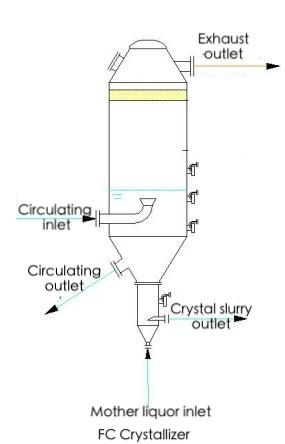
A typical FC crystallizer mainly consists of the following components:
• Heating chamber (heat exchanger)
• Evaporative crystallization chamber
• Upper and lower circulation pipelines
• Forced circulation pump
During operation, the crystal slurry collected from the bottom of the crystallization chamber is continuously circulated by an axial-flow circulation pump.
The slurry passes through the external heat exchanger, where heat is supplied or removed depending on the process requirement. The conditioned slurry is then returned to the crystallization chamber, forming a continuous external circulation loop.
During this circulation process:
1. Heat transfer occurs in the external heat exchanger;
2. Controlled evaporation generates supersaturation;
3. Crystal growth takes place inside the crystallization chamber;
4. The circulation system continuously controls crystal suspension and growth conditions.
Due to the strong circulation and mixing effect, FC crystallizers generally produce relatively uniform crystals, with typical crystal sizes ranging from approximately 0.15 to 0.3 mm depending on process conditions and product characteristics.
Key Operational Features
1. High Circulation Rate
One of the major advantages of FC crystallizers is the high circulation velocity of the crystal slurry.
The high circulation rate provides:
• Improved heat transfer efficiency;
• More uniform temperature distribution;
• Better control of supersaturation levels;
• Reduced secondary nucleation.
By minimizing excessive nucleation, the formation of undesirable fine crystals can be reduced, improving product quality and downstream separation performance.
2. External Heat Exchanger Design
The separation of the heating surface from the crystallization chamber provides several operational advantages:
• Easier inspection and maintenance;
• Simplified cleaning procedures;
• Reduced impact of scaling and fouling;
• Better suitability for viscous or scaling-prone solutions.
This configuration is particularly beneficial for processes involving solutions with high salt concentration or high fouling tendency.
Important Design Considerations
1. Elevation Difference Between Crystallization Chamber and Heat Exchanger
For evaporative FC crystallizers, proper elevation arrangement between the crystallization chamber and the heat exchanger is critical.
Normally, the liquid level of the crystallization chamber should be positioned approximately 4–6 meters higher than the upper tube sheet of the heat exchanger.
This hydrostatic pressure difference helps prevent boiling at the heat exchanger inlet, avoiding:
• Premature crystallization inside heat exchanger tubes;
• Crystal deposition;
• Tube blockage;
• Reduced heat transfer performance.
2. Circulation Pipe Velocity Design
The circulation pipeline design must consider both flow stability and vapor formation caused by vacuum operation.
Typical recommended flow velocities are:
Upper circulation pipe:
• Velocity: < 1.0 m/s
Lower circulation pipe:
• Velocity: 1.5–2.0 m/s
The higher velocity in the lower circulation line helps maintain suspended crystals and prevents sedimentation, while the lower velocity in the upper line accommodates possible vapor bubbles generated during flashing under vacuum conditions.
3. Circulation Pipe Diameter Design
To prevent flash boiling and unstable circulation, the diameter of the upper circulation pipe is normally designed slightly larger than the lower circulation pipe.
This provides sufficient flow area for vapor-liquid mixtures that may form when the hot slurry enters the crystallization chamber.
For systems operating under relatively low vacuum conditions, the upper and lower circulation pipes may adopt the same diameter.
Typical Applications
Due to its reliable operation and flexible design, FC crystallizers are widely used in various industrial crystallization processes, including:
Chemical Industry
• Ammonium sulfate crystallization
• Sodium chloride crystallization
• Potassium sulfate crystallization
• Ammonium chloride crystallization
Fertilizer Industry
• Recovery and purification of inorganic fertilizer salts
• Concentration and crystallization of process liquors
Pharmaceutical and Fine Chemical Industry
• Production of high-purity crystalline products
• Treatment of concentrated solutions requiring controlled crystallization
Conclusion
The External Circulation Crystallizer (FC Type) is a proven and economical crystallization technology for medium- and large-scale industrial applications.
Its external circulation configuration provides excellent control over heat transfer, supersaturation, and crystal suspension, while offering advantages such as simple structure, reliable operation, and convenient maintenance.
Due to these characteristics, FC crystallizers remain one of the preferred solutions for industrial salt crystallization and chemical process applications worldwide.
Enchem is here to listen to your needs and provide sustainable solutions. Contact us to discover more.Get In Touch With US