• Home
  • About Us
  • Products
    • MVR Evaporator
    • MEE Evaporator
    • Distillation & Concentration Unit
    • Complete Equipment
  • Featured Project
    • Chemical Industry
    • Lithium Battery Industry
    • Wastewater Treatment
    • Food & Pharmaceutical
  • Blog
  • Contact
  • Download

MVR Evaporator for Landfill Leachate Treatment

Home Featured Project Wastewater Treatment MVR Evaporator for Landfill Leachate Treatment

MVR Evaporator for Landfill Leachate Treatment

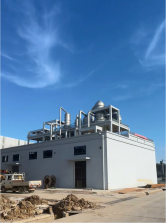
Landfill leachate treatment presents significant challenges due to its complex composition, high alkalinity, high silicon content, and strong scaling potential during concentration. In this project, a customized MVR  forced circulation evaporation system was developed to efficiently concentrate the leachate while ensuring long-term operational reliability. 

Equipment: MVR Forced circulation evaporator;

Feed:  VAI filtrate;

Treatment capacity: 20,000kg/h;

Evaporation capacity: 18,000kg/h;

Feed concentration: approx. 2%;

Concentrate: Readily crystallizes upon cooling;

Installed power: 1,208kw;

Specific power consumption: Approx. 50kWh/t of water evaporated.  
Wastewater Treatment2025-08-03e22 Tags: MVR, wastewater treatment

Description

Project Overview

Landfill leachate and related high-salinity wastewater can present significant treatment challenges due to complex composition, high alkalinity, high silicon content, corrosion potential, and severe scaling tendency during concentration.

For this project, a customized MVR (Mechanical Vapor Recompression) forced circulation evaporation and crystallization system was developed to concentrate the wastewater, separate crystallized salts, and recover the concentrated liquid for reuse.

The system was designed with particular attention to material compatibility, scaling control, energy efficiency, and long-term operating stability.

Project Challenges

The wastewater treated in this project was characterized by high alkalinity, high silicon content, and various dissolved inorganic salts. As the wastewater is concentrated, these components can create several challenges for an evaporation system, including:•   increased scaling and fouling tendency;

•   crystallization of dissolved salts;

•   potential blockage of heat-transfer surfaces;

•   material corrosion and compatibility issues; and

•   reduced heat-transfer efficiency during long-term operation.

Material selection was another important consideration.

Under the required operating conditions, the wastewater showed poor compatibility with conventional titanium materials. Selecting suitable materials of construction was therefore essential to ensure reliable long-term operation.To verify material compatibility, our R&D team conducted an intensive three-month corrosion resistance evaluation under representative operating conditions.Based on the test results, the materials of construction were optimized for the actual wastewater characteristics, providing improved corrosion resistance and equipment durability.

Process Solution   

A customized MVR (Mechanical Vapor Recompression) forced circulation evaporation system was selected for the concentration and crystallization process.  

Before evaporation, the wastewater undergoes appropriate pretreatment, including silicon removal, to reduce the scaling load entering the evaporation system.

The pretreated feed is then introduced into the MVR forced circulation evaporator.

During operation, the process liquid is continuously circulated through the heat exchanger at a high circulation rate. Water is evaporated while dissolved salts become progressively concentrated.

As the concentration increases and the solution approaches supersaturation, crystals begin to form. The resulting crystal slurry is transferred to a centrifuge for solid-liquid separation.

The separated crystalline solids are collected for appropriate disposal or further utilization depending on their composition and process requirements.

The separated mother liquor can be returned to the evaporation system for further concentration, while the required purge and recycle strategy is controlled according to the accumulation of impurities and overall process requirements.

Following silicon removal, evaporation, crystallization, and solid-liquid separation, the concentrated process stream can be recovered and recycled according to the requirements of the production process, contributing to both resource recovery and wastewater reduction.

Process Flow 

Feed Solution → MVR Forced Circulation Evaporation → Concentration & Crystallization → Centrifuge Separation → Crystalline solids

Mother liquor → Recycle/ Controlled purge 

This process combines water evaporation, crystallization, and solid-liquid separation to reduce wastewater volume while enabling recovery of valuable process streams where applicable.

Why Forced Circulation Evaporation?

Forced circulation evaporation is particularly suitable for wastewater that becomes highly concentrated, scaling-prone, or crystallizing during evaporation.

Instead of relying on natural circulation, a circulation pump maintains a high liquid velocity through the heat exchanger.

This provides several important advantages:

•   improved circulation of high-concentration liquid;

•   reduced risk of crystal deposition inside heat-transfer tubes;

•   better control of scaling and fouling;

•   improved handling of crystal-containing slurry; and

•   more stable operation during concentration and crystallization.

For this project, these characteristics were particularly important because the concentrated solution has a strong tendency to crystallize.

MVR Energy Recovery

The system uses Mechanical Vapor Recompression to recover the energy contained in the secondary vapor generated during evaporation.

Instead of rejecting this vapor and continuously supplying large quantities of fresh steam, the vapor is compressed to increase its pressure and saturation temperature.

The compressed vapor is then reused as the heating medium for the evaporator.

This allows the system to achieve an evaporation capacity of approximately 18,000 kg/h with a specific electrical power consumption of approximately 50 kWh per ton of water evaporated under the project design conditions.

Main System Configuration 

The complete system mainly consists of:

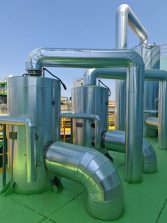
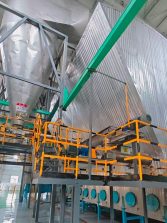
•  Forced circulation evaporator

Designed for high-concentration and high-salt wastewater treatment, providing excellent circulation performance and reducing scaling risk.

•  MVR vapor recompression unit

Compresses and recycles secondary vapor as the heating source for the evaporation process, significantly reducing the requirement for continuous external steam.

•  Vapor-liquor Separation and Demisting system

Reduces liquid droplet entrainment in the secondary vapor before it enters the MVR compressor, helping protect the compressor and improve condensate quality.

•  Centrifuge separation system

Separates crystallized solids from the concentrated slurry and returns the separated mother liquor to the appropriate process stage.

•  Automatic control system

Provides continuous monitoring and automatic control of key operating parameters to support stable and reliable operation.

Key Advantages

•  Customized Corrosion-Resistant Design

Material selection was optimized based on intensive corrosion testing to ensure reliable operation under highly alkaline and high-silicon conditions.

•  Low Energy Consumption

MVR technology significantly reduces steam consumption by recovering and reusing secondary vapor as the heating source.

•  Effective Scaling Control

The forced circulation design maintains high flow velocity inside heat exchanger tubes, reducing the risk of blockage and scaling during high-concentration operation.

•  Resource Recovery and Waste Reduction

The system enables salt recovery and recycling of concentrated solutions, supporting sustainable wastewater management and improving overall process economics.

•  Stable Continuous Operation

Optimized process design and automatic control ensure reliable long-term operation with reduced maintenance requirements.

Application Fields

The MVR forced circulation evaporation systems can be considered for application including:  

•  Landfill leachate and landfill-related high-salinity wastewater;

•  High-salt industrial wastewater;

•  Scaling-prone wastewater;

•  Crystallizing wastewater;

•  Chemical process wastewater concentration;

•  Evaporation and crystallization systems; and

•  Wastewater volume reduction and resource recovery.

An Integrated Approach to Complex Wastewater Treatment

Successful evaporation of complex wastewater requires more than simply selecting an evaporator.

Feed composition, scaling tendency, corrosion behavior, crystallization characteristics, pretreatment requirements, material selection, energy consumption, and final solids handling all need to be considered together.

In this project, the combination of silicon removal, MVR forced circulation evaporation, controlled crystallization, centrifuge separation, and process-stream recycling provided an integrated solution for treating a challenging high-alkalinity and high-silicon wastewater stream.

By matching the evaporation technology and materials of construction to the actual characteristics of the wastewater, the system can achieve efficient water removal, controlled crystallization, reduced waste volume, and reliable long-term operation.


Inquiry Us


Related Products

Anhydrous Calcium Chloride Granulation & Drying System

2025-09-01e22

Potassium-Sodium Separation Evaporator

2025-07-10e22

Triple-Effect Forced Circulation Evaporator for Reverse Osmosis Concentrate

2025-05-16e22

Product Categories

  • Product
    • MVR Evaporator
    • MEE Evaporator
    • Distillation & Concentration Unit
    • Complete Equipment
  • Featured Project
    • Lithium Battery Industry
    • Wastewater Treatment
    • Chemical Industry
    • Food & Pharmaceutical

Product Tags

CaCl2 concentrator crystallization Distillation evaporation Lithium Battery Industry MEE MVR wastewater treatment

Latest Post

  • MVR Evaporation for Landfill Leachate RO Concentrate Treatment
    2026-09-17
  • Why Does an MVR Evaporator Require Mother Liquor Purge?
    2026-09-10
  • Two-Stage Fluidized Bed Drying for Calcium Chloride Granulation: Improving Product Quality, Energy Efficiency, and Operational Stability
    2026-09-02

Email Newsletters

Welcome to subscribe email newsletter to us, get the lastest products and news information from us!

Contact Us

+86-135 875 13702

info@enchem-tech.com

info@enchem-tech.com

Zengdu District, Suizhou City, Hubei Province, China

Mobile Website

Copyright © 2012-2017 Wenzhou Enchem Technology Co.,Ltd. All Rights Reserved Design by enchem-tech.com