• Home
  • About Us
  • Products
    • MVR Evaporator
    • MEE Evaporator
    • Distillation & Concentration Unit
    • Complete Equipment
  • Featured Project
    • Chemical Industry
    • Lithium Battery Industry
    • Wastewater Treatment
    • Food & Pharmaceutical
  • Blog
  • Contact
  • Download

DDGS Production Line for Corn Ethanol Plants

Home Product Complete Equipment DDGS Production Line for Corn Ethanol Plants

DDGS Production Line for Corn Ethanol Plants

Our DDGS production line provides an integrated solution for converting corn ethanol stillage into high-protein Distillers Dried Grains with Solubles (DDGS).

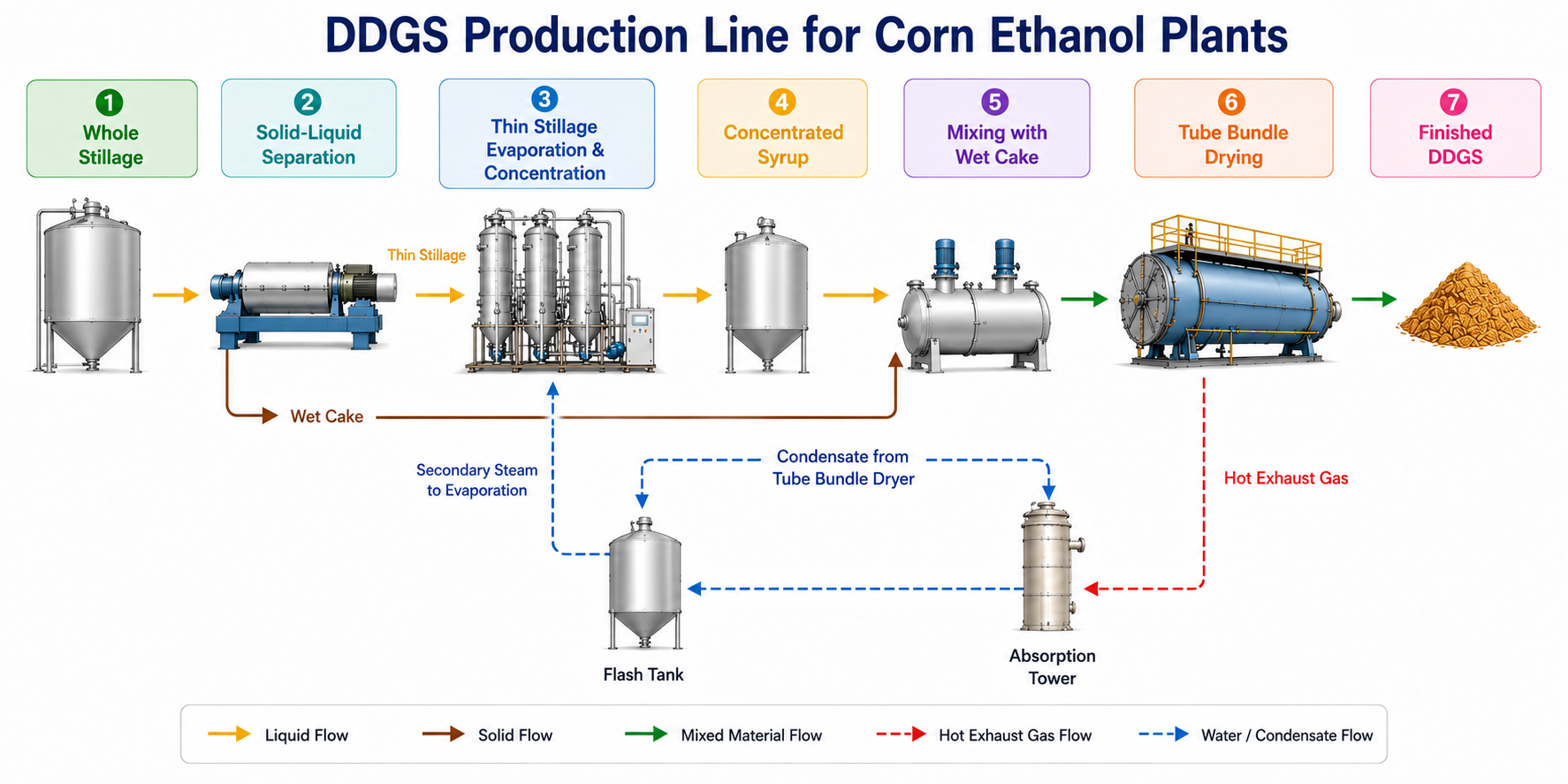
The complete process includes solid-liquid separation, thin stillage evaporation and concentration, syrup and wet cake mixing, and tube bundle drying.

A key feature of the system is the integration of multi-effect evaporation with tube bundle drying. Heat from dryer condensate and exhaust gas is recovered through flash evaporation and exhaust gas absorption, generating secondary steam for reuse in the evaporation system.

This integrated process improves thermal energy utilization, reduces fresh steam consumption, and provides a reliable and energy-efficient solution for DDGS production.
Complete Equipment2026-08-29e22 Tags: concentrator, evaporation

Description

1.DDGS Production from Corn Ethanol Stillage

DDGS (Distillers Dried Grains with Solubles), is a valuable co-product generated during the production of ethanol from corn and other cereal grains.

During ethanol production, starch contained in corn is converted into fermentable sugars and subsequently fermented into ethanol. After ethanol is recovered through distillation, the remaining whole stillage contains water together with valuable components such as protein, fat, fiber, minerals and other nutrients.

In a typical corn ethanol production process, approximately 3.05 tons of corn are consumed to produce one ton of ethanol, while approximately 11–14 tons of stillage are generated.

Through solid-liquid separation, evaporation, concentration and drying, the valuable nutrients contained in the stillage can be recovered and converted into DDGS, providing both economic value and efficient utilization of ethanol production by-products.

2. DDGS Production Process

A typical DDGS production line consists of the following main processing stages:

Whole Stillage → Solid-Liquid Separation → Wet Cake + Thin Stillage → Thin Stillage Evaporation & Concentration → Concentrated Syrup → Mixing with Wet Cake → Tube Bundle Drying → Cooling →Finished DDGS

The solid-liquid separation, evaporation and drying sections are closely intergrated. Proper matching of these process sections is essential for stable continuous production, efficient water removal and reduced overall energy consumption.

3.Solid-Liquid Separation of Whole Stillage

After ethanol distillation, the remaining whole stillage is sent to the DDGS processing section and separated, typically by a decanter centrifuge, into two main streams: wet cake and thin stillage.

Wet Cake

The solid-rich fraction contains most of the insoluble protein, fiber and other nutrients. It is transferred to the mixing section, where it is combined with concentrated syrup before drying.

Thin Stillage

The liquid fraction contains a large amount of water together with dissolved and fine suspended organic solids.

Since these soluble components have nutritional value, the thin stillage is sent to the evaporation system for concentration rather than being discarded.

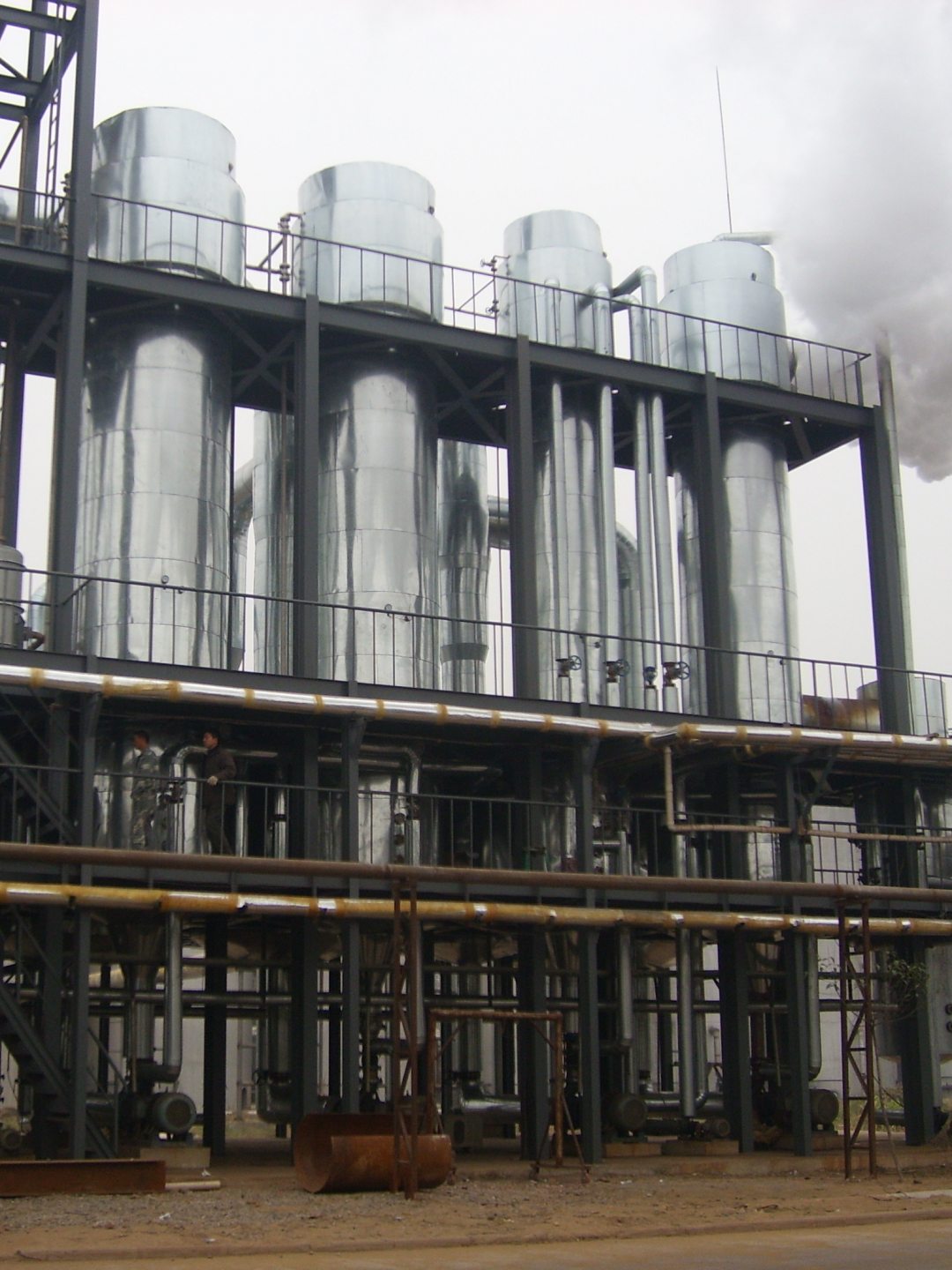
4. Thin Stillage Multi-Effect Evaporation

The evaporation system is a key section of the DDGS production line.

Thin stillage has a relatively high water content. If this water were removed entirely in the dryer, the drying system would require a much higher thermal load.

Therefore, the thin stillage is first concentrated in a multi-effect evaporation system, where a substantial portion of the water is removed and the dissolved solids are concentrated into syrup.

Multi-effect evaporation allows vapor generated during evaporation to be utilized between different effects, improving thermal energy utilization and reducing fresh steam demand.

The evaporation system is customized according to:

•   Thin stillage processing capacity;

•   Feed solids concentration;

•   Required syrup concentration;

•   Stillage viscosity and fouling characteristics;

•   Available steam conditions;

•   Available recovered heat;

•   Required DDGS production capacity;

•   Overall material and heat balance.

The concentrated syrup is subsequently transferred to the mixing section.

5. Concentrated Syrup and Wet Cake Mixing

The concentrated syrup from the evaporation system contains the soluble nutrients recovered from the thin stillage.

It is uniformly mixed with the wet cake from the solid-liquid separation section before entering the dryer.

Proper mixing helps achieve:

•   Maximum recovery of soluble and insoluble nutrients;

•   Uniform dryer feed composition;

•   Stable feed moisture;

•   Consistent final DDGS quality;

•   Stable operation of the tube bundle dryer.

The mixed material is then continuously fed into the drying system.

6. Tube Bundle Drying System

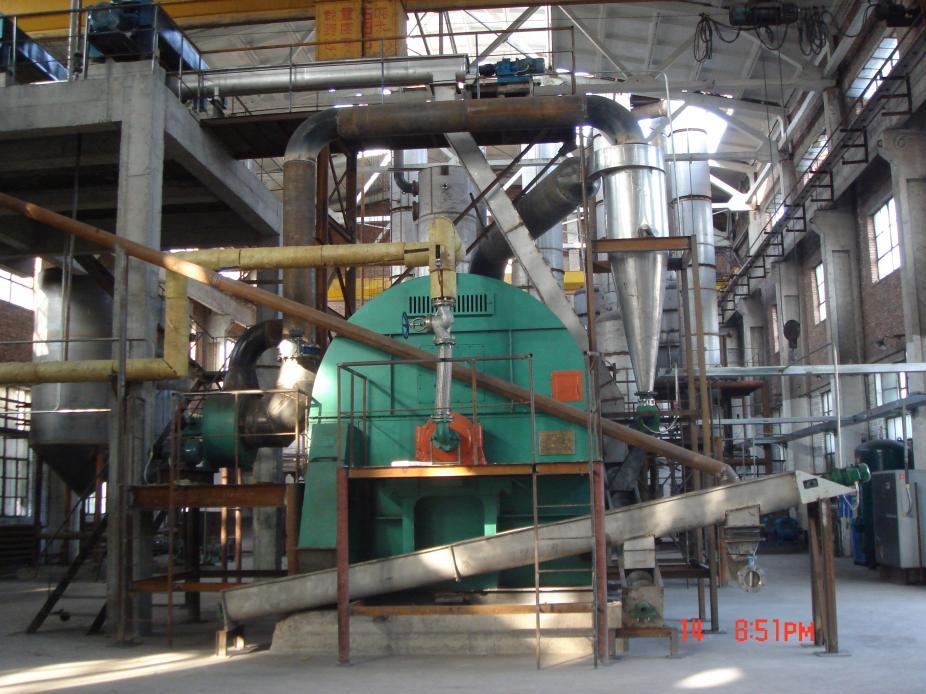
The DDGS production line adopts a tube bundle dryer for final moisture removal.

The tube bundle dryer is an indirect steam-heated drying system. Heating steam flows inside the tube bundle and transfers heat through the tube walls to the wet DDGS material without direct contact between the heating steam and the product.

During operation, rotation of the tube bundle continuously agitates and redistributes the material, providing effective contact with the heated surfaces and promoting uniform evaporation of moisture.

Advantages of Tube Bundle Drying for DDGS

The tube bundle dryer provides several advantages:

•   Large heat-transfer surface;

•   High thermal efficiency;

•   Indirect steam heating;

•   Continuous drying operation;

•   Uniform mixing and heat transfer;

•   Stable control of final product moisture;

The dryer is designed according to feed capacity, inlet moisture, final product moisture requirements, steam conditions and the overall plant heat balance.

Final DDGS moisture can typically be controlled to 12% or below, depending on the required product specification.

7. Heat Recovery from the Tube Bundle Dryer

A key energy-saving feature of the DDGS production line is the recovery and reuse of waste heat from the tube bundle dryer.

The hot condensate from the tube bundle dryer is sent to a flash tank, where secondary steam is generated through flash cooling and reused as a heating source for the evaporation system.

Meanwhile, the hot dryer exhaust gas is washed in an absorption tower, where its heat is transferred to circulating water. The heated circulating water is then flashed to generate secondary steam for further use in the evaporation system.

Heat Recovery Routes:

Dryer Condensate → Flash Tank → Secondary Steam → Evaporator

Dryer Exhaust Gas → Absorption Tower → Heated Circulating Water → Flash Tank → Secondary Steam → Evaporator

By recovering heat from both the dryer condensate and exhaust gas, the system reduces fresh steam consumption and improves the overall thermal efficiency of the DDGS production line.

8. Integrated Evaporation and Drying Design

The evaporation system and tube bundle dryer are not designed as two independent units. Instead, they form an integrated thermal system.

On the material side:

Thin Stillage → Multi-Effect Evaporation → Concentrated Syrup → Mixing with Wet Cake → Tube Bundle Drying → DDGS

On the energy side:

Tube Bundle Dryer → Condensate & Exhaust Heat Recovery → Secondary Steam → Multi-Effect Evaporation

This creates an effective energy cycle between evaporation and drying.

The evaporator removes a substantial portion of water before the material enters the dryer, reducing the dryer moisture load. At the same time, thermal energy from the dryer is recovered and returned to the evaporation process.

By combining multi-effect evaporation, tube bundle drying, condensate flash recovery and dryer exhaust heat recovery, the overall system can achieve improved thermal efficiency and reduced fresh steam consumption.

9. Automatic Process Control

The complete DDGS production line can be integrated with a PLC or DCS automatic control system for continuous and coordinated operation.

Typical monitored and controlled parameters include:

•   Whole stillage feed flow;

•   Tank liquid levels;

•   Evaporator temperature and pressure;

•   Syrup concentration;

•   Steam pressure and flow;

•   Dryer operating temperature;

•   DDGS product moisture;

•   Flash tank pressure;

•   Circulating water temperature;

•   Pump and motor operating status;

•   Equipment alarms and safety interlocks.

Automatic control helps maintain stable operating conditions and coordinates the evaporation, drying and heat recovery systems.

10. CIP Cleaning System

Thin stillage contains proteins, organic compounds and fine suspended solids that may gradually accumulate on heat-transfer surfaces.

A CIP (Cleaning-in-Place) system can therefore be incorporated for periodic cleaning of the evaporation system and associated process pipelines.

The evaporator design also considers suitable circulation conditions, equipment accessibility and cleaning requirements to maintain stable heat-transfer performance during long-term continuous operation.

11. Typical Technical Parameters

The DDGS production line is customized according to the actual operating conditions of each ethanol plant.

Parameter

Typical Reference

Raw material

Corn / Maize

Corn consumption

Approx. 3.05 t/t ethanol

Stillage generation

Approx. 11–14 t/t ethanol

Ethanol plant capacity

Approx. 50,000–200,000 t/year

DDGS production capacity

Approx. 10–50 t/h

Evaporation technology

Multi-effect evaporation

Drying technology

Tube bundle dryer

Dryer heating method

Indirect steam heating

Heat recovery

Condensate + dryer exhaust heat recovery

Final DDGS moisture

≤12%

DDGS protein content

≥27%

Operation mode

Continuous

Automation

PLC / DCS

Typical Utility Consumption

Typical reference values according to the process configuration shown include:

•   Electricity consumption: approximately 160–180 kWh/t DDGS

•   Steam consumption: approximately 2.8–3.15 t/t DDGS

•   Circulating cooling water: approximately 120–160 t/t DDGS

The above values are provided as general reference data only. Actual production capacity, product quality and utility consumption depend on raw material characteristics, feed conditions, process configuration, steam conditions and available waste heat.

12. Energy-Efficient DDGS Production Solution

The large amount of stillage generated during corn ethanol production makes energy-efficient water removal one of the most important considerations in DDGS processing.

Our DDGS production solution combines solid-liquid separation, multi-effect evaporation, tube bundle drying and integrated waste heat recovery into a continuous process.

By recovering thermal energy from both the tube bundle dryer condensate and dryer exhaust gas and returning this energy to the evaporation system in the form of secondary steam, the process makes more effective use of available thermal energy and reduces fresh steam demand.

The complete DDGS production line can be customized according to the customer’s ethanol production capacity, stillage flow and composition, DDGS product requirements, available steam and site utility conditions, providing a reliable and energy-efficient solution for corn ethanol stillage processing.


Inquiry Us


Related Products

Waste Hydrochloric Acid Recycling Solution and Calcium Chloride Production Solution

2025-12-28e22

Anhydrous Calcium Chloride Granulation & Drying System

2025-09-01e22

Potassium-Sodium Separation Evaporator

2025-07-10e22

Product Categories

  • Product
    • MVR Evaporator
    • MEE Evaporator
    • Distillation & Concentration Unit
    • Complete Equipment
  • Featured Project
    • Lithium Battery Industry
    • Wastewater Treatment
    • Chemical Industry
    • Food & Pharmaceutical

Product Tags

CaCl2 concentrator crystallization Distillation evaporation Lithium Battery Industry MEE MVR wastewater treatment

Latest Post

  • Calcium Chloride Plant in Algeria Reaches Key Commissioning Milestone
    2026-08-12
  • Comparison of DTB, Oslo, and FC Crystallizers: Principles, Characteristics, and Applications
    2026-06-05
  • Achieving Low Residual Moisture Content in Industrial Salt Crystallization Processes
    2026-05-27

Email Newsletters

Welcome to subscribe email newsletter to us, get the lastest products and news information from us!

Contact Us

+86-135 875 13702

info@enchem-tech.com

info@enchem-tech.com

Zengdu District, Suizhou City, Hubei Province, China

Mobile Website

Copyright © 2012-2017 Wenzhou Enchem Technology Co.,Ltd. All Rights Reserved Design by enchem-tech.com