• Home
  • About Us
  • Products
    • MVR Evaporator
    • MEE Evaporator
    • Distillation & Concentration Unit
    • Complete Equipment
  • Featured Project
    • Chemical Industry
    • Lithium Battery Industry
    • Wastewater Treatment
    • Food & Pharmaceutical
  • Blog
  • Contact
  • Download

Falling-Film Evaporator

Home Product MEE Evaporator Falling-Film Evaporator

Falling-Film Evaporator

A falling film evaporator is an efficient thermal separation system widely used for the concentration of heat-sensitive aqueous and organic solutions.

It is particularly suitable for products such as milk, glucose, oligosaccharides, sorbitol, and fruit and vegetable juices, and is extensively applied in industries including food processing, pharmaceuticals, bioengineering, chemical engineering, deep grain processing, and environmental protection.

Falling film evaporators can be configured as single-effect, multi-effect, or MVR (Mechanical Vapor Recompression) systems, enabling flexible adaptation to different energy and capacity requirements. They are characterized by high heat transfer efficiency, low operating temperature, short residence time, and excellent product quality retention.
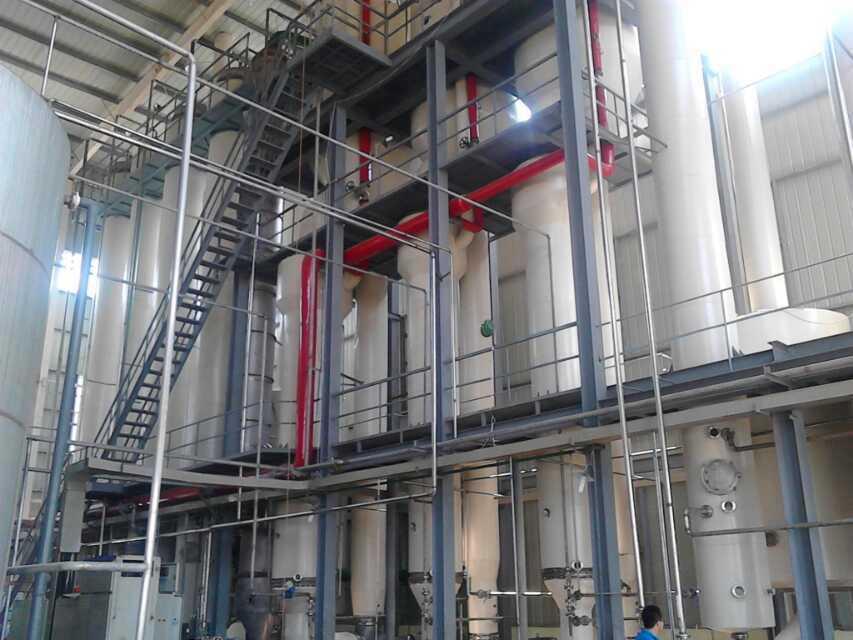
MEE Evaporator, Distillation & Concentration Unit2024-03-24e22 Tags: MEE

Description

Evaporation is a cornerstone process in many industries, from food and beverage to pharmaceuticals. And the falling film evaporator stands out for its efficiency and gentle handling of heat-sensitive products, is suitable for solutions such as milk, glucose, oligosaccharides, sorbitol, fruit and vegetable juice, etc. It is widely used in the evaporation and concentration of aqueous solutions and organic solvent solutions in industries such as food processing, pharmaceuticals, deep processing of grain, bioengineering, environmental engineering, and etc.

Principle of Falling-Film Evaporator  

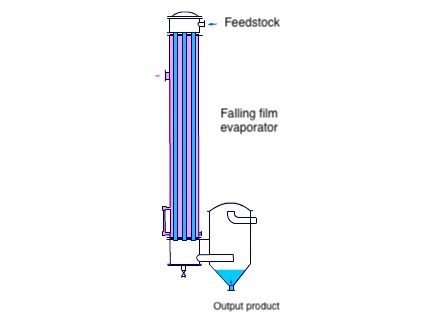
The falling film evaporator operates under vacuum conditions and utilizes a thin liquid film flowing downward along the inner surface of heat exchange tubes, which significantly enhances heat transfer efficiency.

In this system, the feed is introduced through a distribution unit at the top of the heater, where it is evenly distributed into each heat exchange tube to form a uniform thin film. Under the combined effects of gravity, vacuum, and vapor flow, the liquid film flows downward along the tube walls. During this process, the material is heated by the heating medium on the shell side and begins to evaporate.

The resulting vapor–liquid mixture enters the separator, where efficient phase separation occurs. The vapor is directed to the condenser for condensation (in single-effect systems) or to the next effect as a heating medium (in multi-effect systems). The concentrated liquid is discharged from the separator for further processing.

Types of Falling-Film Evaporator  

• Single-effect falling film evaporator

• Multi-effect falling film evaporators (Double-effect, Triple-effect, Four-effect, Five-effect)

• MVR (Mechanical Vapor Recompression) falling film evaporators

Application Range of Falling-Film Evaporator  

Falling film evaporators operate under vacuum and low-temperature conditions, offering high evaporation efficiency, low energy consumption, and low operating costs while largely preserving the original properties of the materials.

They are widely used across multiple industries, including:

1) Food Industry

Concentration of milk, fruit and vegetable juices, syrups, etc., while preserving heat-sensitive nutrients and flavor.

2) Chemical Industry

Concentration of chemical solutions, solvent recovery, and processing of temperature-sensitive chemical products.

3) Pharmaceuticals

Concentration of drug solutions and solvent removal while maintaining the integrity of active pharmaceutical ingredients.

4) Wastewater Treatment

Concentration of industrial effluents and recovery of valuable components or solvents.

Components & Design of Falling-Film Evaporator

A typical falling film evaporator consists of the following main components:

1) Heater

A heat exchanger that transfers thermal energy to the product, enabling evaporation.

2) Separator

A vessel where vapor is separated from the concentrated liquid.

3) Condenser

Condenses vapor into liquid. In multi-effect systems, condensation also helps maintain system vacuum by controlling pressure conditions.

4) Vacuum System

Provides and maintains the required vacuum level for low-temperature evaporation.

5) Transfer Pumps

Including feed pumps, discharge pumps, and condensate pumps.

6) Thermal vapor recompressor (optional)

A portion of secondary steam is recycled through a thermal vapor recompressor (TVR) back into the heating chamber of the first effect, improving heat utilization. This results in lower steam consumption and reduced cooling water demand. The steam enters in a finely dispersed state, ensuring gentle heating, making it especially suitable for heat-sensitive materials.

7) CIP System (optional)

Clean-in-Place system for efficient and convenient automatic cleaning.

8) Integrated Sterilization Function (optional)

For heat-sensitive materials, sterilization and concentration can be combined in a single process. The material is preheated, sterilized, and then flash evaporated in the first effect, where rapid pressure reduction ensures minimal thermal damage.

9) MVR  (optional)

A mechanical vapor compressor (MVR) can be integrated to form an MVR falling film evaporator. In this system, all secondary vapor is compressed and reused as the heating medium, enabling maximum heat recovery with extremely low steam and cooling water consumption.

Advantages of Falling-Film Evaporator

• High Efficiency

High heat transfer coefficients due to uniform film formation and efficient steam-liquid contact.

• Low Temperature Operation

Vacuum operation reduces boiling point, making it ideal for heat-sensitive materials.

• Energy Saving

Can be configured as multi-effect or TVR or MVR systems, significantly reducing energy consumption.

• High Product Quality

Short residence time minimizes thermal degradation and preserves product quality.

• High Scalability

Suitable for both small-scale and large-scale industrial applications.

• High Automation Level

Can be fully automated for stable operation and minimal manual intervention.

Inquiry Us


Related Products

Containerized Low-Temperature Heat Pump Crystallization Evaporator

2026-04-12e22

Containerized Low-Temperature Heat Pump Concentration Evaporator

2026-04-12e22

MVR Distillation Technology

2025-06-15e22

Product Categories

  • Product
    • MVR Evaporator
    • MEE Evaporator
    • Distillation & Concentration Unit
    • Complete Equipment
  • Featured Project
    • Lithium Battery Industry
    • Wastewater Treatment
    • Chemical Industry
    • Food & Pharmaceutical

Product Tags

CaCl2 concentrator crystallization Distillation Lithium Battery Industry MEE MVR wastewater treatment

Latest Post

  • Successful Commissioning of Instant Coffee Liquor 4-Effect Evaporator Upgrading Project in Indonesia
    2026-03-22
  • Evaporator Equipment Driving Efficiency in Lithium Battery Recycling
    2026-02-02
  • Lithium Battery Recycling: Recovering Valuable Materials for a Sustainable Energy Future
    2026-01-22

Email Newsletters

Welcome to subscribe email newsletter to us, get the lastest products and news information from us!

Contact Us

+86-135 875 13702

info@enchem-tech.com

info@enchem-tech.com

Zengdu District, Suizhou City, Hubei Province, China

Mobile Website

Copyright © 2012-2017 Wenzhou Enchem Technology Co.,Ltd. All Rights Reserved Design by enchem-tech.com