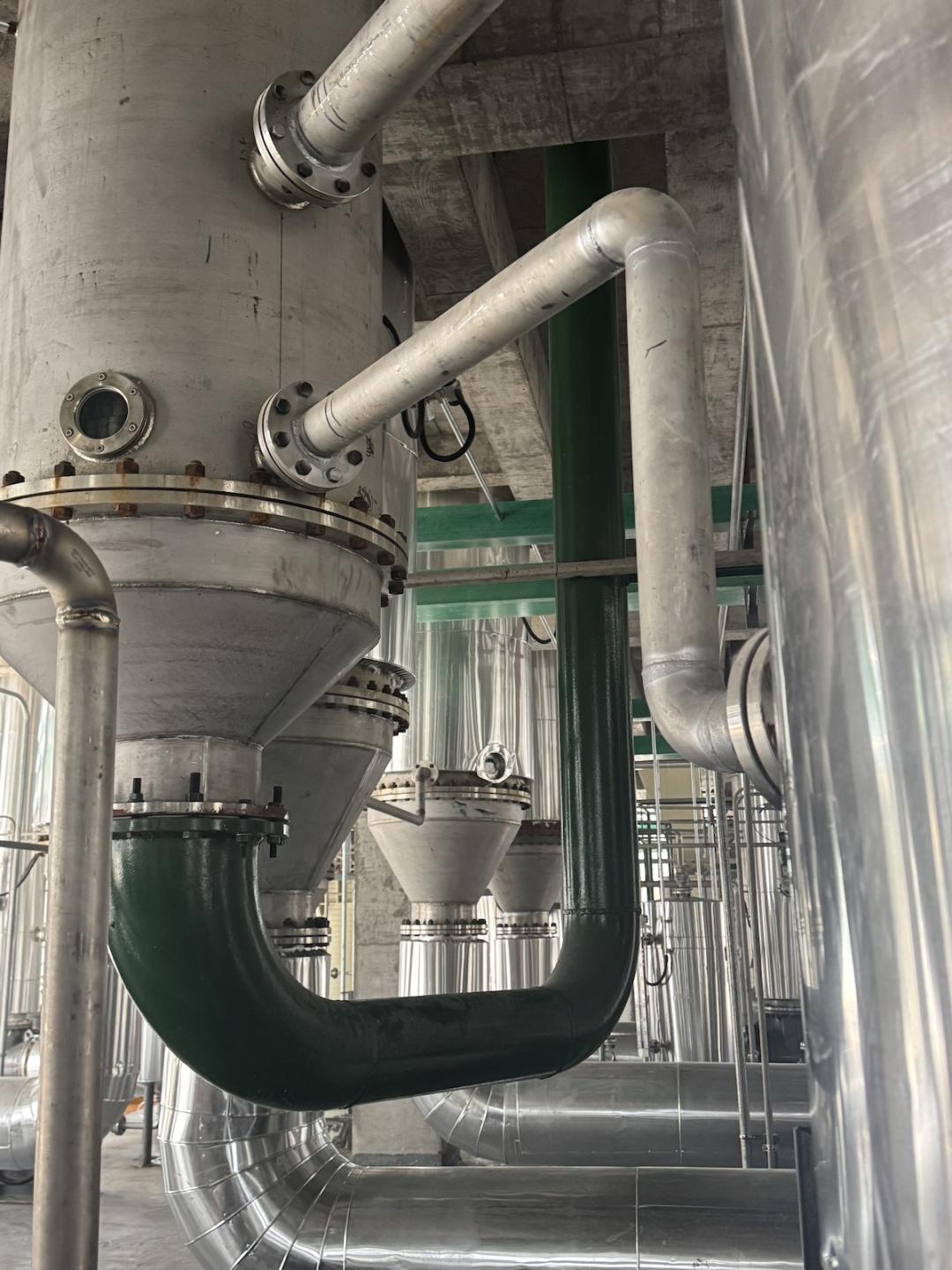
Crystallization is an important solid-liquid separation process in which dissolved substances in a solution are converted into solid crystals through controlled changes in temperature, concentration, or solvent conditions.
During crystallization, atoms, ions, or molecules arrange themselves into an ordered structure, forming crystals with specific shapes and sizes. By controlling supersaturation, nucleation, and crystal growth conditions, crystallization enables efficient recovery of valuable solid products with consistent quality.
In industrial applications, crystallization processes are generally classified into two main types:
1. Evaporation Crystallization
Evaporation crystallization is a process that generates supersaturation by removing solvent from a solution through evaporation. As the solvent is continuously evaporated, the concentration of dissolved solute gradually increases from an unsaturated state to a saturated and eventually supersaturated state.
When the solubility limit is exceeded, the excess solute precipitates from the solution in the form of crystals. By continuously controlling evaporation conditions, crystal formation and growth can be achieved efficiently.
Evaporation crystallization is widely used in chemical and inorganic salt production, particularly for large-scale continuous processes requiring high recovery rates and stable operation.
2. Cooling Crystallization
Cooling crystallization is a process that produces crystals by reducing the temperature of a saturated solution. It is mainly applied to substances whose solubility decreases significantly with decreasing temperature.
During the cooling process, the solubility of the dissolved substance decreases, causing the solution to become supersaturated. The excess solute then precipitates in the form of crystals.
Cooling crystallization is commonly used for materials with strong temperature-dependent solubility characteristics, where precise temperature control is required to achieve the desired crystal size and quality.
The selection of evaporation crystallization or cooling crystallization depends on the solubility characteristics of the material, product requirements, energy availability, and production capacity.
Industrial Crystallizer Types
Industrial crystallizers are designed to control supersaturation, nucleation, crystal growth, and crystal size distribution, ensuring stable operation and consistent product quality.
According to the circulation pattern, crystal growth mechanism, and process requirements, continuous crystallizers are mainly classified into the following three types:
1. Forced Circulation Crystallizer
A forced circulation crystallizer uses a circulation pump to maintain a high flow rate of crystal slurry through an external heat exchanger and the crystallization chamber.
The high circulation velocity improves heat transfer efficiency, reduces the risk of scaling on heat transfer surfaces, and provides a uniform supersaturation environment for stable crystal growth.
Advantages of forced circulation crystallizers include:
• Suitable for high-concentration and high-solids applications
• Excellent resistance to scaling and fouling
• Stable continuous operation
• Applicable for large-scale industrial production
Forced circulation crystallizers are widely used for inorganic salt production, including potassium sulfate, ammonium chloride, sodium sulfate, and other chemical products.
2. DTB (Draft Tube Baffle) Crystallizer
The DTB crystallizer is equipped with an internal draft tube and baffle structure to optimize crystal circulation and classification.
The draft tube creates a controlled circulation pattern, allowing smaller crystals to remain in the circulation zone while larger crystals can grow and settle. This design provides excellent control of crystal size distribution and improves product quality.
Advantages of DTB crystallizers include:
• Excellent crystal size control
• Reduced secondary nucleation
• Production of high-quality crystals
• Suitable for applications requiring narrow crystal size distribution
DTB crystallizers are commonly used in industries requiring precise crystal quality control.
3. OSLO Crystallizer
The OSLO crystallizer utilizes a fluidized bed growth principle, where crystals grow in a controlled suspension zone with relatively low supersaturation.
By separating crystal growth and nucleation zones, the OSLO crystallizer minimizes secondary nucleation and promotes the formation of larger crystals.
Advantages of OSLO crystallizers include:
• Production of large crystal sizes
• High crystal quality
• Efficient solid-liquid separation
• Suitable for large-scale continuous crystallization processes
OSLO crystallizers are widely applied in industries requiring large particle size and high-quality crystalline products.
Customized Crystallization Solutions
The selection of crystallizer type depends on various factors, including:
• Material solubility characteristics
• Crystal size requirements
• Production capacity
• Solid content and slurry characteristics
• Scaling tendency
• Downstream separation requirements
We, ENCHEM TECHNOLOGY provides customized crystallization solutions, including process design, crystallizer selection, equipment manufacturing, and complete integration with evaporation systems.
Our crystallization technologies are widely applied in chemical production, inorganic salt recovery, wastewater treatment, and zero liquid discharge (ZLD) projects.
Contact Us
Reach out to an optimized proposal