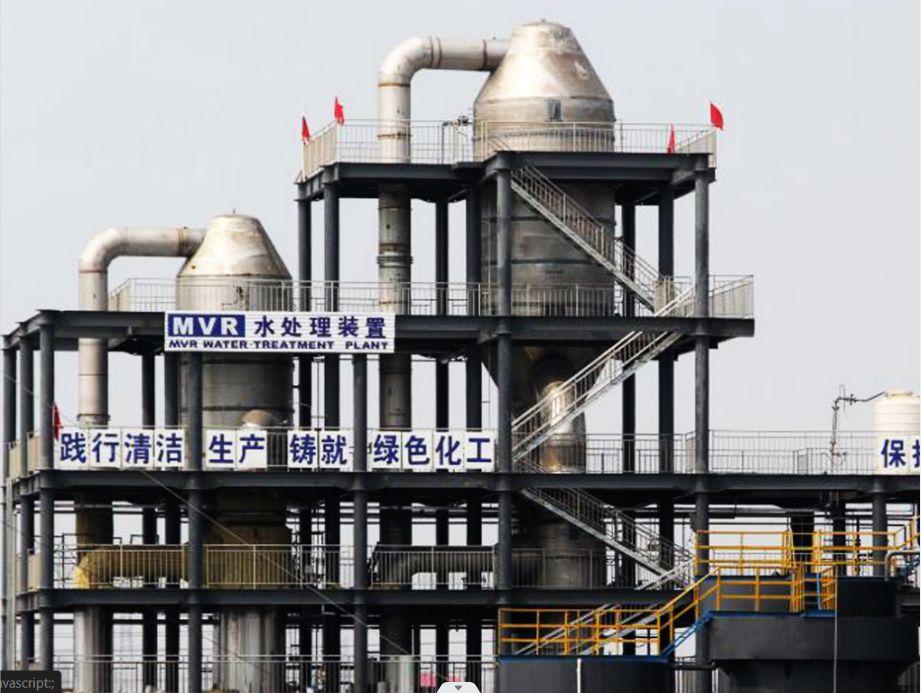
As environmental regulations become increasingly stringent and industrial water resources face growing pressure, Zero Liquid Discharge (ZLD) has become an important solution for sustainable industrial wastewater management.
Mechanical Vapor Recompression (MVR) evaporation technology plays a key role in ZLD systems by efficiently concentrating wastewater, recovering reusable water, and facilitating salt crystallization while minimizing energy consumption.
By integrating MVR evaporation, crystallization, solid-liquid separation, and mother liquor drying, industrial facilities can significantly reduce wastewater discharge, maximize water recovery, and achieve Zero Liquid Discharge objectives.
What Is Zero Liquid Discharge (ZLD)?
Zero Liquid Discharge (ZLD) is an advanced wastewater treatment approach designed to eliminate liquid waste discharge by recovering water and converting dissolved contaminants into solid residues.
A typical ZLD treatment system combines several processes, including:
• Pretreatment: Removal of suspended solids, oil, hardness, and other contaminants.
• Evaporation and Concentration: Removal and recovery of water from wastewater.
• Crystallization: Recovery of dissolved salts as solid crystals.
• Solid-Liquid Separation and Drying: Separation and further treatment of crystallized salts and residual mother liquor.
MVR evaporation and crystallization systems are particularly suitable for the thermal concentration and salt recovery stages of ZLD applications.
How Does MVR Technology Work in ZLD Systems?
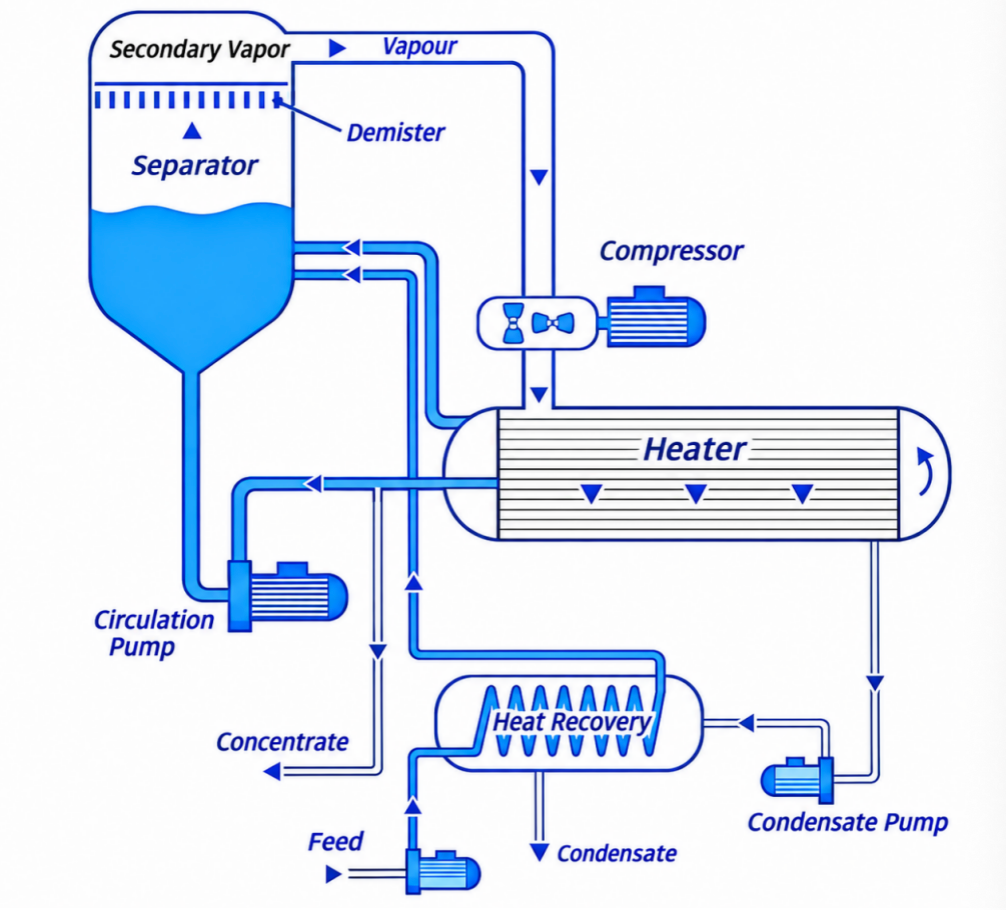
MVR process principle
An MVR evaporator utilizes a mechanical vapor compressor to recover and reuse the latent heat of secondary vapor generated during evaporation.
During operation, wastewater is heated to generate vapor. The secondary vapor is compressed to increase its temperature and pressure, allowing it to be reused as the heating source for the evaporator.
This continuous heat recovery process significantly reduces external steam consumption and improves overall energy efficiency compared with conventional evaporation technologies.
For high-salinity wastewater, forced-circulation MVR evaporators are commonly adopted to maintain sufficient liquid velocity through the heat exchanger, minimize scaling risks, and ensure stable operation.
As wastewater becomes concentrated, dissolved salts may crystallize and can subsequently be separated using centrifuges or other solid-liquid separation equipment.
Integrated MVR Zero Liquid Discharge Process
A complete MVR-based ZLD system generally consists of the following treatment stages:
1. Wastewater Pretreatment
Depending on the wastewater characteristics, pretreatment may include oil removal, filtration, chemical softening, and other processes to remove suspended solids, hardness, and contaminants that could affect evaporation performance.
Proper pretreatment helps minimize fouling and scaling, improving the reliability and operating efficiency of the MVR evaporator.
2. MVR Evaporation and Concentration
The pretreated wastewater enters the MVR evaporator, where water is evaporated and recovered as condensate.
Through mechanical vapor recompression, the latent heat of secondary vapor is reused for heating, significantly reducing external energy requirements.
The wastewater is progressively concentrated, reducing its volume and preparing it for subsequent crystallization.
3. Salt Crystallization
As the wastewater concentration increases, dissolved salts reach supersaturation and begin to crystallize.
Depending on the salt composition and solubility characteristics, different crystallization can be adopted, including FC type, DTB type or OSLO type crystallizers.
Controlled crystallization promotes the crystal growth, improves solid-liquid separation, and supports stable system operation.
4. Liquor-solid Separation
The crystallized slurry is transferred to a centrifuge to separate solid salts from the mother liquor.
The separated salts are collected for further drying, recovery, or disposal, depending on their composition and quality.
Most of the mother liquor is returned to the crystallization system for continued processing.
5. Mother Liquor Purge and Drying
During continuous evaporation and crystallization, highly soluble salts and other impurities gradually accumulate in the circulating mother liquor.
To prevent excessive impurity buildup and maintain stable crystallization conditions, a controlled portion of the mother liquor may need to be discharged from the system.
Instead of disposing of this concentrated liquid as wastewater, a dedicated Mother Liquor Drying System can be incorporated to further remove moisture and convert the discharged mother liquor into solid residues.
Depending on the characteristics of the mother liquor, suitable drying technologies may include:
• Rotary Drum Scraper Dryer
• Hollow Paddle Dryer
• Other Specialized Drying Equipment
The dried residues are collected for appropriate handling or disposal in accordance with applicable environmental regulations.
By integrating mother liquor drying with MVR evaporation and crystallization, the system can minimize residual liquid waste and support complete ZLD operation.
6. Condensate Recovery and Reuse
The vapor generated during evaporation is condensed and collected as recovered water.
Depending on the condensate quality and reuse requirements, additional treatment may be applied before the water is returned to industrial processes.
This reduces freshwater consumption and improves overall water resource utilization.
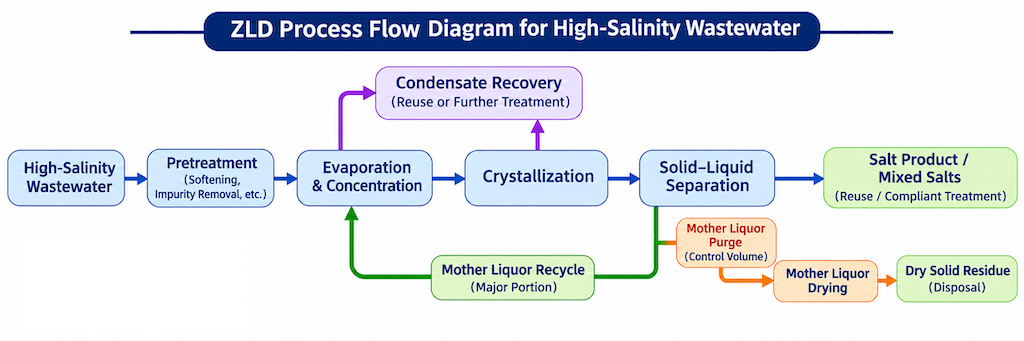
ZLD process flow
Key Advantages of MVR Evaporators for ZLD Applications
• High Energy Efficiency
MVR technology recovers and reuses secondary vapor heat, significantly reducing external steam consumption and operating costs compared with conventional multiple-effect evaporation systems.
• Maximum Water Recovery
By combining evaporation, crystallization, and final drying, MVR-based ZLD systems can achieve high water recovery rates and substantially reduce liquid waste discharge.
• Effective Treatment of High-Salinity Wastewater
Forced-circulation MVR systems are suitable for treating concentrated brine and salt-containing wastewater. Proper circulation and crystallization control help minimize scaling and maintain stable operation.
• Reduced Waste Disposal Costs
Converting wastewater into recovered water and solid residues significantly reduces the volume of liquid waste requiring off-site treatment or disposal.
• Stable and Automated Operation
PLC-based automation enables continuous monitoring and control of key operating parameters, including temperature, pressure, liquid level, concentration, and compressor operation.
• Flexible Process Configuration
MVR evaporation systems can be customized and integrated with different crystallization, separation, and drying technologies to accommodate various wastewater characteristics and treatment requirements.
Typical Industrial Applications
MVR evaporation and crystallization systems are widely applicable to industrial wastewater treatment, particularly for high-salinity and difficult-to-treat wastewater streams.
• Metallurgical and Metal Refining Industry
Treatment of saline wastewater generated from metal processing, refining, and surface treatment operations.
• Chemical and Petrochemical Industry
Concentration and crystallization of high-TDS process wastewater, including brine and chemical production effluents.
• Pharmaceutical Industry
Treatment of selected high-salinity and organic wastewater streams, subject to appropriate pretreatment and process evaluation.
• Reverse Osmosis (RO) Reject Water
Further concentration of RO reject streams to maximize water recovery and reduce the volume of concentrated brine.
• Industrial Wastewater Treatment
Wastewater volume reduction, salt recovery, and final residue drying for industrial facilities pursuing near-ZLD or complete ZLD objectives.
Customized MVR Evaporation and ZLD Solutions
We specialize in the design and supply of MVR evaporation, crystallization, and drying systems for industrial wastewater treatment and Zero Liquid Discharge applications.
Our solutions can be customized according to wastewater composition, treatment capacity, target water recovery, operating conditions, and available utilities.
From wastewater pretreatment and MVR concentration to salt crystallization, centrifugal separation, and mother liquor drying, we provide integrated process solutions designed to improve energy efficiency, reduce wastewater disposal costs, and support sustainable industrial operations.
Whether your project involves high-salinity wastewater, industrial brine, or complex process effluent, our engineering team can help evaluate a suitable MVR evaporation and crystallization solution.
Contact us to discuss your wastewater characteristics, treatment capacity, and ZLD requirements. We would be pleased to provide a customized technical proposal for your project.
Contact US
Enchem is here to listen to your needs and provide sustainable solutions. Contact us to discover more.