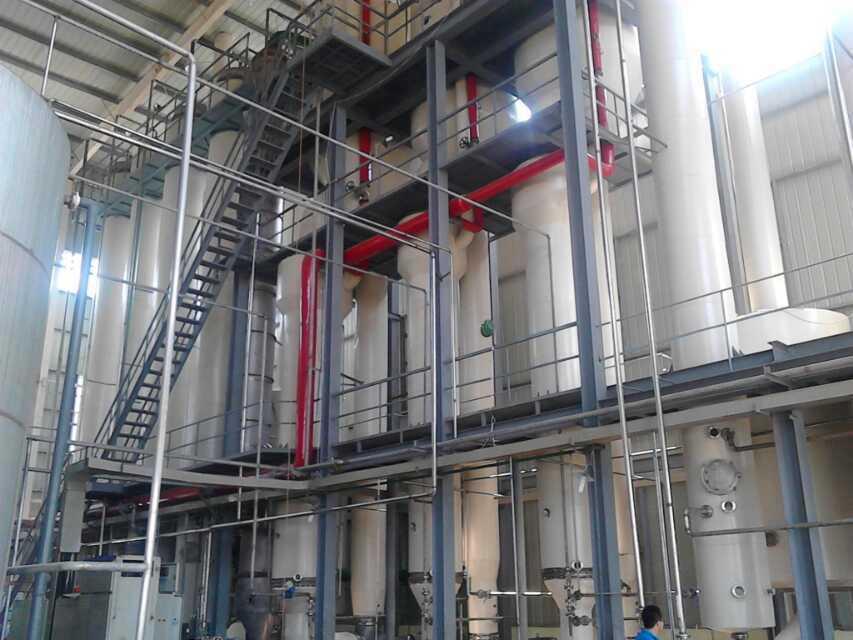
Principle of Rising Film Evaporator
In the field of evaporation technology, a common observation reveals an interesting phenomenon: a vertical evaporator with a much smaller volume can achieve significantly higher evaporation efficiency than a horizontal evaporator under the same operating conditions. This phenomenon is closely related to the unique heat transfer mechanism of vertical evaporators, especially the rising film evaporator.
The evaporation efficiency of an evaporator is directly related to its heat transfer performance. Therefore, understanding the principle of a rising film evaporator starts with analyzing its internal heat transfer mechanism.
In a rising film evaporator, evaporation mainly takes place inside the vertical heating tubes. During operation, the liquid feed enters the bottom of the heating tubes and is heated by the external heating medium. As evaporation proceeds, the generated vapor drives the liquid upward along the tube wall, gradually forming a thin liquid film. The entire evaporation process can generally be divided into six stages: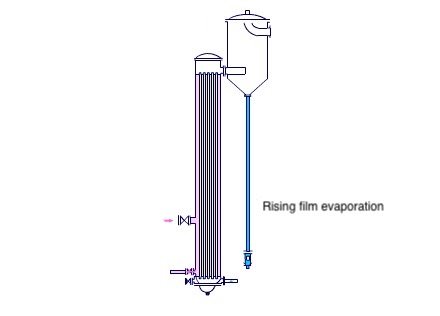
1. Preheating stage
2. Bubble formation stage
3. Emulsification stage
4. Transition stage
5. Film formation stage
6. Vapor flow stage
Since evaporation is essentially completed during the vapor flow stage, the main heat transfer process occurs from the preheating stage to the film formation stage.
From the first stage to the fifth stage, the heat transfer efficiency continuously increases, reaching its maximum during the film formation stage. The reason is that the formation of a thin liquid film significantly enhances heat transfer performance, resulting in much higher evaporation efficiency compared with conventional evaporators.
Why does a thin film provide better heat transfer efficiency?
The key factor is the significant reduction of the liquid boundary layer thickness. A thinner boundary layer reduces thermal resistance between the heating surface and the liquid, allowing heat to transfer more efficiently and accelerating the evaporation process.
Improvement of Rising Film Evaporator
Based on the above analysis, the formation of a stable thin liquid film is the key factor determining the performance of a rising film evaporator. Therefore, improving evaporation efficiency mainly focuses on accelerating and optimizing the film formation process.
To understand how to improve film formation, it is necessary to analyze the conditions required for generating a stable liquid film.
Conditions for Film Formation
1. Sufficient vapor generation
A certain amount of vapor must be generated to drive the liquid upward and form a continuous film along the heating tube wall. When vapor generation is insufficient, such as during the initial preheating and bubble formation stages, stable film flow cannot be established.
2. Proper gas-liquid ratio
Stable film formation requires the gas-liquid ratio to remain within an appropriate range. An unsuitable ratio may result in poor liquid distribution or unstable film flow.
3. Same-direction flow of vapor and liquid
A stable liquid film is formed when the vapor and liquid flow in the same direction. Counter-current flow conditions are unfavorable for maintaining a continuous liquid film.
4. Sufficient vapor velocity
The vapor velocity must reach a certain level to effectively entrain and spread the liquid along the tube wall, promoting film formation.
5. Sufficient liquid flow rate
The liquid flow rate must also be maintained within an appropriate range to ensure complete wetting of the heating surface and stable film coverage.
Key Methods to Improve Rising Film Evaporator Performance
Based on the film formation mechanism, the evaporation efficiency of a rising film evaporator can be improved through the following approaches:
1. Generate vapor as early as possible
Accelerating initial vapor generation shortens the time required to reach the film formation stage, allowing the evaporator to operate at high heat transfer efficiency for a longer period.
2. Optimize feed distribution and liquid loading
Proper control of the feed rate and liquid distribution ensures that the gas-liquid ratio quickly reaches the optimal range for stable film formation.
3. Optimize flow direction and equipment configuration
Since liquid naturally tends to flow downward due to gravity, falling film evaporators have an inherent advantage in film formation. For rising film evaporators, optimizing the internal flow structure is essential to overcome this limitation and improve film stability.
4. Optimize operating velocity
The vapor and liquid flow velocities directly influence film formation. Through optimized equipment design and operating control, the flow conditions can be maintained within the ideal range, improving heat transfer efficiency and overall evaporation performance.
Summary
The core advantage of a rising film evaporator lies in the formation of a thin liquid film inside the heating tubes. By reducing thermal resistance and enhancing heat transfer, the film formation process significantly improves evaporation efficiency.
Therefore, the key to improving rising film evaporator performance is to accelerate film formation, optimize gas-liquid flow conditions, and maintain stable thin-film operation through proper equipment design and process control.
Contact Us
Reach out to an optimized proposal