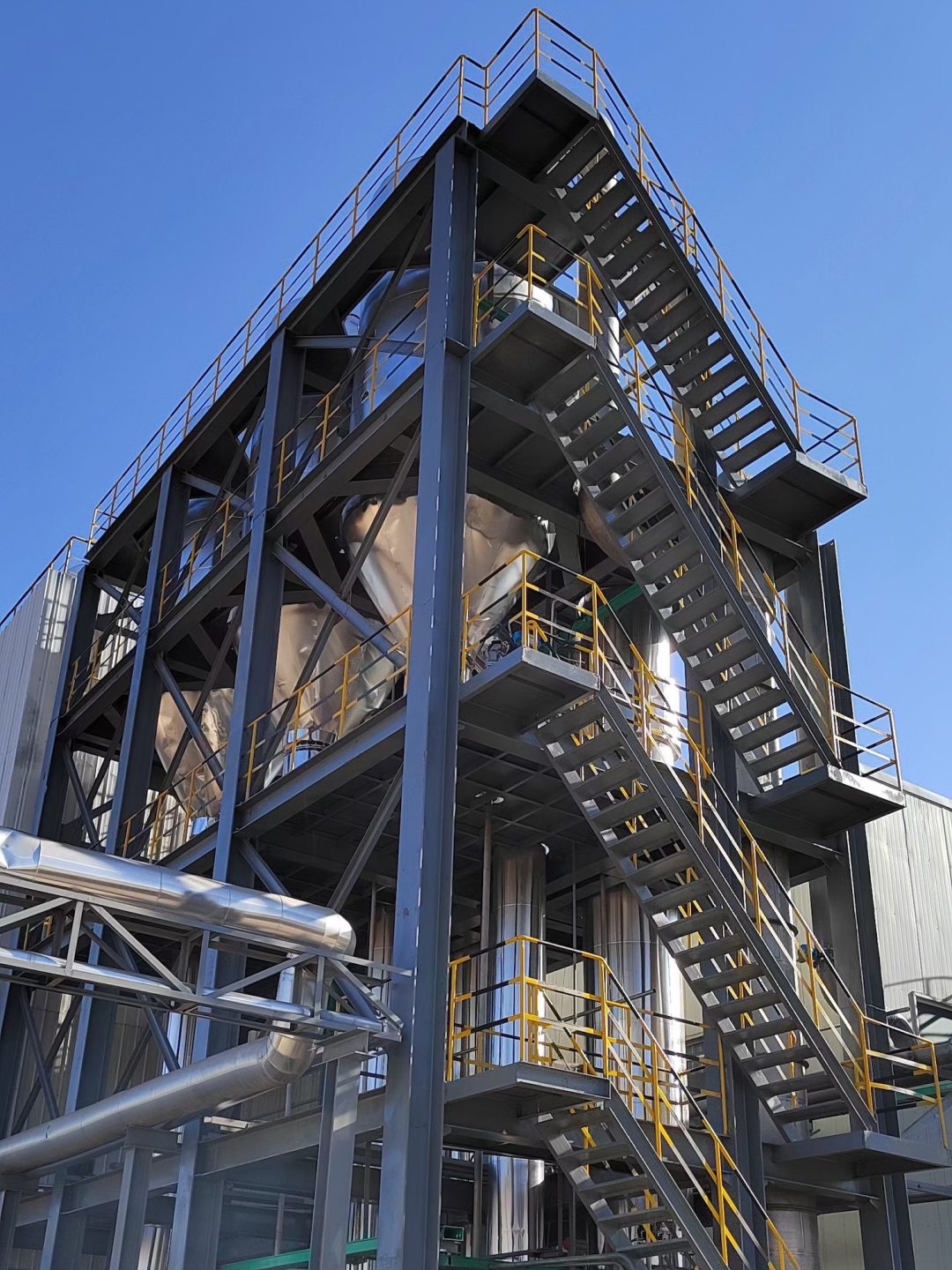
Operating Principle of MVR Evaporator
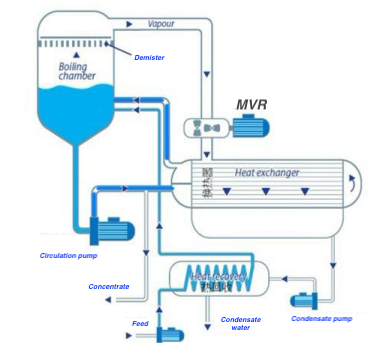 A Mechanical Vapor Recompression (MVR) evaporator is an advanced energy-saving evaporation system that utilizes the latent heat of secondary steam generated during the evaporation process.
During operation, the secondary steam produced from the evaporated liquid is collected and compressed by a mechanical vapor compressor. The compression process increases the pressure, temperature, and enthalpy of the secondary steam. The high-temperature compressed steam is then returned to the heating chamber as the heating medium to provide the required evaporation heat.
After releasing heat through condensation, the compressed steam becomes condensate, while the recovered latent heat is continuously reused within the system. Through this closed-loop vapor circulation process, the MVR evaporator significantly reduces the consumption of fresh steam and improves overall thermal efficiency compared with conventional evaporation technologies.
Inlet Water Quality Requirements for MVR Evaporator
The feed quality of an MVR evaporator has a direct impact on system efficiency, operational stability, and equipment service life. Proper evaluation of feed characteristics is essential before selecting an MVR evaporation system.
1. Low Boiling Point Elevation Requirement
The steam compressor is the key component of an MVR evaporator. The available temperature increase generated by the compressor is limited; therefore, the boiling point elevation (BPE) of the feed solution should be minimized.
Generally, the boiling point elevation of the feed liquid is recommended to be less than 15°C to ensure efficient operation and reasonable compressor power consumption.
In theory, higher temperature rises can be achieved through multi-stage vapor compression. However, multi-stage compression significantly increases power consumption, equipment complexity, and operational risks. Therefore, MVR systems are generally more suitable for solutions with moderate boiling point elevation.
2. Material Compatibility Requirements
Most components of an MVR evaporator system, including preheaters, heating chambers, separators, vapor compressors, vacuum systems, and cleaning systems, are manufactured using metallic materials.
Therefore, feed materials containing highly corrosive substances, such as strong acids, strong alkalis, or highly aggressive chemical components, require careful material selection and corrosion evaluation before applying MVR technology.
For highly corrosive applications, alternative materials or specially designed evaporation technologies may be required.
3. Requirements for Volatile, Flammable, and Explosive Components
If the feed liquid contains volatile, flammable, or explosive substances, safety risks may occur during vapor compression due to the concentration and compression of combustible gases.
For such applications, a detailed safety assessment is required, and MVR evaporation should only be considered when appropriate explosion-proof design and safety measures are available.
4. Suitability for Clean and Stable Feed Materials
MVR evaporators are generally more suitable for relatively clean feed streams.
High concentrations of suspended solids, scaling components, or impurities may lead to:
• Rapid fouling of heat transfer surfaces;
• Reduced heat transfer efficiency;
• Increased cleaning frequency;
• Unstable operation of the vapor compressor.
Therefore, pretreatment systems such as filtration, clarification, softening, or chemical treatment may be required depending on the feed characteristics.
Recommended Inlet Quality Indicators for MVR Evaporator
To ensure stable and efficient operation, the following feed quality indicators are commonly recommended:
1. Calcium and Magnesium Content
• Ca²⁺ + Mg²⁺: Recommended below 100 mg/L
High concentrations of calcium and magnesium ions may cause rapid scaling during evaporation, especially under high concentration conditions, resulting in reduced heat transfer performance and increased maintenance requirements.
2. Silicon and Silicate Content
• Silicon / Silicates: Recommended below 30 mg/L
Excessive silicon or silicate content may generate hard scale deposits on heat transfer surfaces, affecting evaporation efficiency and equipment reliability.
3. Cyanide Content
• Cyanides should be avoided
Cyanide-containing materials require special safety evaluation. Leakage or improper handling may create serious safety risks, including toxic exposure and potential chemical hazards.
4. pH Range
• Recommended pH range: 5–8
Extremely acidic or alkaline conditions may accelerate corrosion of metallic components and affect equipment service life.
5. Fluoride Ion Content
• Fluoride ions: Recommended below 20 ppm
Fluoride ions are highly corrosive to titanium materials, which are commonly used in evaporation systems due to their excellent corrosion resistance. Excessive fluoride concentration may cause corrosion and damage to titanium heat transfer components.
Conclusion
MVR evaporation technology provides an efficient and environmentally friendly solution for industrial wastewater treatment, process concentration, and resource recovery. However, successful application depends greatly on proper evaluation of feed characteristics, including boiling point elevation, corrosive components, scaling tendency, and impurity levels.
By optimizing inlet quality and selecting appropriate pretreatment measures, MVR evaporators can achieve long-term stable operation, high energy efficiency, and reliable performance in various industrial applications.
Contact US
Please feel free to reach out for proposals