Boiling Point Elevation (BPE)
Boiling Point Elevation (BPE) is the phenomenon in which the boiling point of a solution is higher than that of the pure solvent due to the presence of dissolved non-volatile solutes. As a colligative property, BPE depends primarily on the concentration of dissolved particles rather than their chemical identity.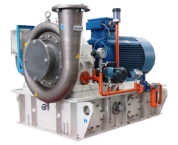
In industrial evaporation processes, dissolved salts and other solutes increase the boiling point of the solution above that of pure water. As the solution becomes more concentrated during evaporation, the boiling point continues to rise, making BPE an important design parameter throughout the evaporation process.
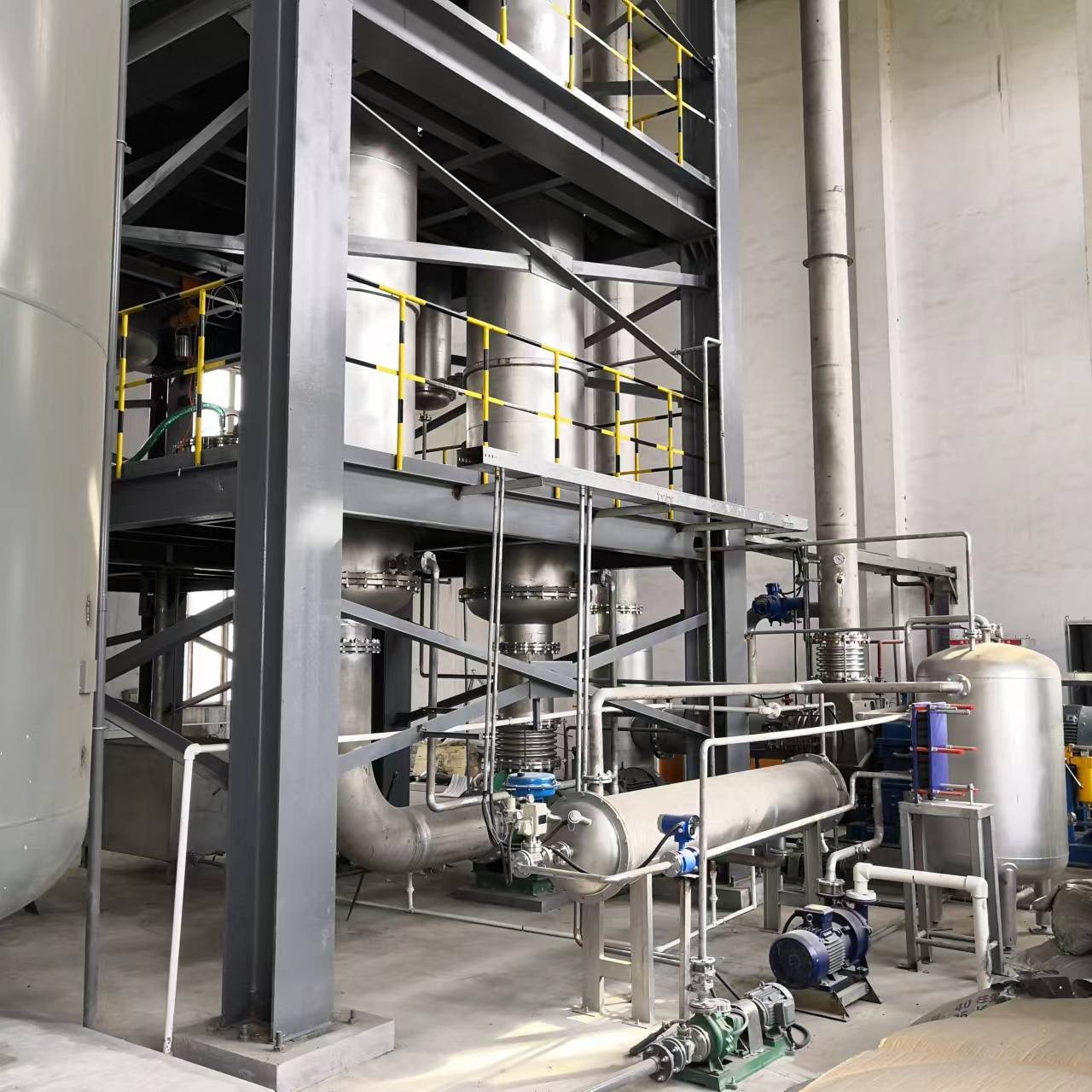
Among all evaporation technologies, BPE has the greatest impact on Mechanical Vapor Recompression (MVR) systems. Unlike conventional evaporators that rely primarily on external steam, MVR systems recycle secondary vapor by mechanically increasing its pressure and temperature. Consequently, the magnitude of the BPE directly determines the required temperature lift, compressor power, heat transfer performance, and, ultimately, the technical and economic feasibility of the entire system.
BPE Reduces The Effective Temperature Difference (ΔT)
An MVR evaporator operates by compressing secondary vapor and reusing it as the heating medium.
The available driving force for heat transfer is the temperature difference (ΔT) between the compressed vapor and the boiling solution.
As the boiling point of the solution increases due to BPE, this effective temperature difference decreases.
A smaller ΔT results in:
• Lower heat transfer rates.
• Larger heat transfer surfaces.
• Higher equipment costs.
• Reduced overall thermal efficiency.
If the available ΔT becomes too small, the evaporator may no longer be able to provide sufficient heat transfer for stable operation.
BPE Increases Compressor Power Consumption
The vapor compressor is the largest consumer of electricity in an MVR system.
To overcome a higher boiling point, the compressor must generate a greater temperature lift by increasing the vapor pressure.
As BPE increases, the compressor must perform more work, leading to:
• Higher electricity consumption.
• Larger compressor capacity.
• Increased equipment investment.
• Higher operating costs.
For this reason, accurate BPE prediction is one of the most important factors in compressor selection and sizing.
BPE Limits the Achievable Concentration
Boiling Point Elevation increases as the solution becomes more concentrated.
For solutions with high salt concentrations or complex chemical compositions, the BPE may become sufficiently large that further concentration becomes increasingly difficult and energy-intensive.
In extreme cases:
• Evaporation rates decrease significantly.
• Compressor power requirements become uneconomical.
• The target concentration may no longer be technically achievable using MVR alone.
Therefore, high-BPE solutions require careful evaluation during process design.
BPE Influences Overall Process Selection
Boiling Point Elevation is one of the key factors in determining whether MVR is the most suitable evaporation technology.
For solutions with relatively low BPE, MVR generally provides outstanding energy efficiency and excellent operating economics.
However, when BPE becomes excessive, the required compression ratio and compressor power may increase beyond practical or economic limits. In such cases, alternative technologies, such as Thermal Vapor Recompression (TVR), Multiple-Effect Evaporation (MEE), or hybrid MVR-MEE systems, may provide a more economical solution.
Consequently, BPE should always be evaluated during the early stages of process design and technology selection.
Engineering Considerations
When designing an MVR evaporator, engineers should accurately determine:
• Boiling Point Elevation (BPE) over the entire concentration range.
• Physical properties of the solution, including viscosity, density, and specific heat.
• Heat transfer coefficients at different concentrations.
• Required compressor temperature lift and compression ratio.
• Heat transfer area and overall equipment sizing.
Accurate thermodynamic data are essential for selecting the appropriate compressor, estimating energy consumption, and ensuring reliable long-term operation.
Summary
Boiling Point Elevation (BPE) is one of the most critical design parameters in Mechanical Vapor Recompression technology. It directly influences heat transfer, compressor power, equipment sizing, achievable product concentration, and overall process economics.
A comprehensive understanding of BPE enables engineers to optimize MVR system design, accurately predict energy consumption, and determine whether MVR, TVR, MEE, or a hybrid evaporation system offers the most technically and economically suitable solution for a given application.
Get In Touch With US
Enchem is here to listen to your needs and provide sustainable solutions. Contact us to discover more.