
Industrial processes often require efficient evaporation and concentration of liquids while minimizing energy consumption and environmental impact. As industries increasingly focus on sustainability and resource optimization, multiple-effect evaporators (MEE) have become a widely used technology for industrial concentration and wastewater treatment applications.
Compared with conventional single-effect evaporators, multiple-effect evaporator makes more efficient use of thermal energy by reusing the vapor generated during evaporation. This significantly reduces fresh steam consumption and improves overall steam economy, making MEE systems particularly suitable for medium- and large- capacity evaporation duties.
Operating Principle of a Multiple-Effect Evaporator
The fundamental principle of a multiple-effect evaporator is cascade heat utilization.
In a typical MEE system, fresh steam is supplied to the first effect to provide the initial heating energy. Instead of being discharged or condensed immediately, the secondary vapor generated from the boiling liquid in the first effect is used as the heating medium for the second effect.
Each subsequent effect operates at a lower pressure and, consequently, at a lower boiling temperature. This temperature difference allows the vapor generated in one effect to provide the latent heat required for evaporation in the following effect.
For example, in a triple-effect evaporator:
Fresh Steam → Effect I → Secondary Vapor → Effect II → Secondary Vapor → Effect III → Condensation
Through this sequential reuse of vapor energy, the same thermal energy contributes to evaporation multiple times before the final vapor is condensed.
As a result, a properly designed multiple-effect evaporation system can substantially reduce fresh steam consumption compared with a single-effect evaporator.
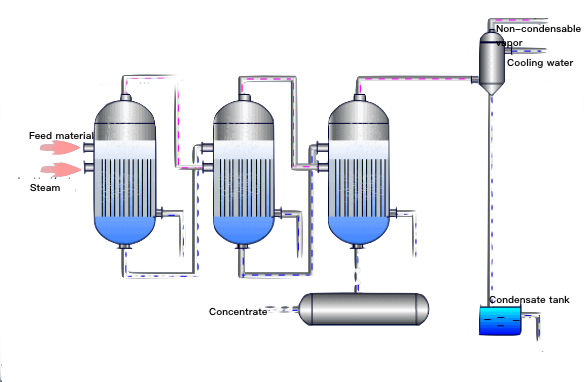
Triple-effect evaporator
Configurations of Multiple-Effect Evaporators
The optimum configuration of a multiple-effect evaporator depends on several factors, including feed composition, evaporation capacity, target concentration, available steam conditions, boiling point elevation (BPE), product characteristics, and required energy efficiency.
Common configurations include:
• Double-Effect Evaporators
A double-effect evaporator consists of two evaporation effects operating at different pressures and temperatures.
It offers a good balance between energy savings, equipment investment, and operational simplicity, making it suitable for small- to medium-capacity industrial applications.
A triple-effect evaporator utilizes three sequential evaporation stages, allowing the secondary vapor to be reused twice before final condensation.
Compared with a double-effect system, it can achieve higher steam economy and is widely applied where steam consumption represents a significant portion of operating costs.
• Four-Effect and Higher-Effect Evaporators
Four-effect and higher-effect evaporation systems can provide further improvements in thermal efficiency and are particularly suitable for large-scale applications with high evaporation loads.
However, increasing the number of effects does not always result in the most economical solution. More effects require additional equipment, heat-transfer area, piping, instrumentation, and capital investment. Furthermore, the available temperature difference must be distributed among more evaporation stages.
Therefore, the optimum number of effects should be determined through a comprehensive technical and economic evaluation rather than simply maximizing the number of evaporation stages.
Feed Arrangements for Multiple-Effect Evaporators
In addition to the number of effects, the feed arrangement is another important consideration in MEE system design.
Depending on the properties of the process solution, multiple-effect evaporators can be configured with:
• Forward feed
Forward-feed arrangements are often suitable when the feed enters at a relatively high temperature or when the concentrated product becomes more heat-sensitive.
• Backward feed
Backward-feed configurations can be advantageous when the solution becomes increasingly viscous as concentration rises, because the highest-concentration liquid is processed in the effect operating at the highest temperature.
• Mixed feed
• Parallel feed
The appropriate feed arrangement should therefore be selected according to the physical properties, viscosity, boiling point elevation, fouling tendency, and thermal sensitivity of the process solution.
Applications of Multiple-Effect Evaporators
Multiple-effect evaporators are widely used in industries requiring liquid concentration, solvent removal, water recovery, or volume reduction.
Typical applications include:
• Chemical and Petrochemical Industries
MEE systems can be used for the concentration of inorganic salts, acids, alkaline solutions, chemical intermediates, and various process liquors.
Typical applications include solutions containing sodium chloride, calcium chloride, ammonium chloride, sodium sulfate, caustic soda, and other inorganic chemicals.
• Food and Beverage Industry
Multiple-effect evaporation is widely applied for concentrating fruit juice, milk and dairy products, sugar solutions, starch derivatives, plant extracts, and other food ingredients.
For heat-sensitive products, evaporation temperature and residence time must be carefully controlled to minimize deterioration in flavor, color, and nutritional quality.
• Pharmaceutical Industry
MEE systems can be applied to the concentration of pharmaceutical solutions, fermentation liquids, extracts, and process intermediates where controlled operating temperatures and stable product quality are required.
• Industrial Wastewater Treatment
Multiple-effect evaporators are extensively used for the concentration of industrial wastewater and high-salinity effluent.
• Pulp and Paper Industry
Concentration of black liquor for chemical recovery and energy generation.
These applications demonstrate the versatility of multiple-effect evaporators in improving production efficiency while supporting environmental sustainability.
Advantages of Multiple-Effect Evaporators
Multiple-effect evaporators offer numerous technical and economic advantages, including:
• Significant Energy Savings
The most important advantage of multiple-effect evaporation is improved steam economy.
By using secondary vapor from one effect as the heating source for the next, the system reduces the amount of fresh steam required per unit of water evaporated.
• High Processing Capacity
These systems are capable of handling large feed volumes continuously, making them suitable for high-capacity industrial production.
• Reduced Cooling Water Consumption
Because thermal energy is recovered and reused between effects, less vapor needs to be condensed using external cooling water compared with conventional single-effect systems.
This can reduce both cooling-water consumption and the load on cooling towers or other heat-rejection equipment.
• Operational Flexibility
Multiple-effect evaporators can be designed using various evaporation technologies, including falling film, forced circulation, natural circulation, and rising film, to accommodate different feed characteristics and process requirements.
They can also be integrated with preheaters, condensate heat recovery, thermal vapor recompression (TVR), crystallization, and other energy-saving technologies to further optimize system performance.
• Lower Environmental Impact
Reduced steam and cooling water consumption translate into lower energy usage, decreased greenhouse gas emissions, and improved overall environmental performance.
Key Design Considerations
The performance of a multiple-effect evaporator depends heavily on proper process design. An MEE system should therefore be engineered according to the actual characteristics of the feed rather than selected solely on the basis of evaporation capacity.
Important design parameters include:
• Feed flow rate and composition
• Initial and target concentrations
• Required evaporation capacity
• Feed temperature
• Product viscosity
• Boiling point elevation (BPE)
• Scaling and fouling tendency
• Crystallization characteristics
• Product heat sensitivity
• Corrosion characteristics
• Available steam pressure and temperature
• Cooling-water conditions
• Required operating pressure and vacuum
• Materials of construction
• Cleaning and maintenance requirements
• Automation and process-control requirements
With appropriate engineering design and maintenance, multiple-effect evaporators can provide long service life, stable performance, and significant reductions in operating costs.
Multiple-Effect Evaporator vs. MVR Evaporator
Both multiple-effect evaporation (MEE) and mechanical vapor recompression (MVR) are widely used energy-saving evaporation technologies, but the optimum solution depends on the specific process conditions.
MEE primarily reduces energy consumption by reusing vapor across multiple effects at progressively lower pressures. MVR, in comparison, uses a mechanical vapor compressor to increase the pressure and temperature of secondary vapor so that it can be reused as the heating source within the evaporation process.
In some projects, MEE and MVR technologies can also be combined to optimize energy consumption, investment cost, and process reliability.
The final technology selection should consider feed characteristics, boiling point elevation, evaporation capacity, available utilities, electricity and steam costs, required concentration, and expected operating hours.
Conclusion
Multiple-effect evaporators are a proven and reliable solution for energy-efficient liquid concentration in chemical processing, food production, pharmaceutical manufacturing, wastewater treatment, and many other industrial applications.
By recovering and reusing the latent heat of secondary vapor through successive evaporation effects, MEE systems can significantly reduce fresh steam consumption while maintaining high processing capacity and stable continuous operation.
However, achieving high efficiency requires more than simply increasing the number of effects. Feed characteristics, boiling point elevation, viscosity, scaling tendency, corrosion, heat-transfer performance, feed arrangement, and available utilities must all be considered during process design.
With proper process engineering, equipment selection, material selection, and automation, a multiple-effect evaporator can provide a reliable, energy-efficient, and cost-effective solution for both industrial production and wastewater concentration applications.
Contact Us
Please feel free to reach out for suitable offer of multiple-effect evaporator.
