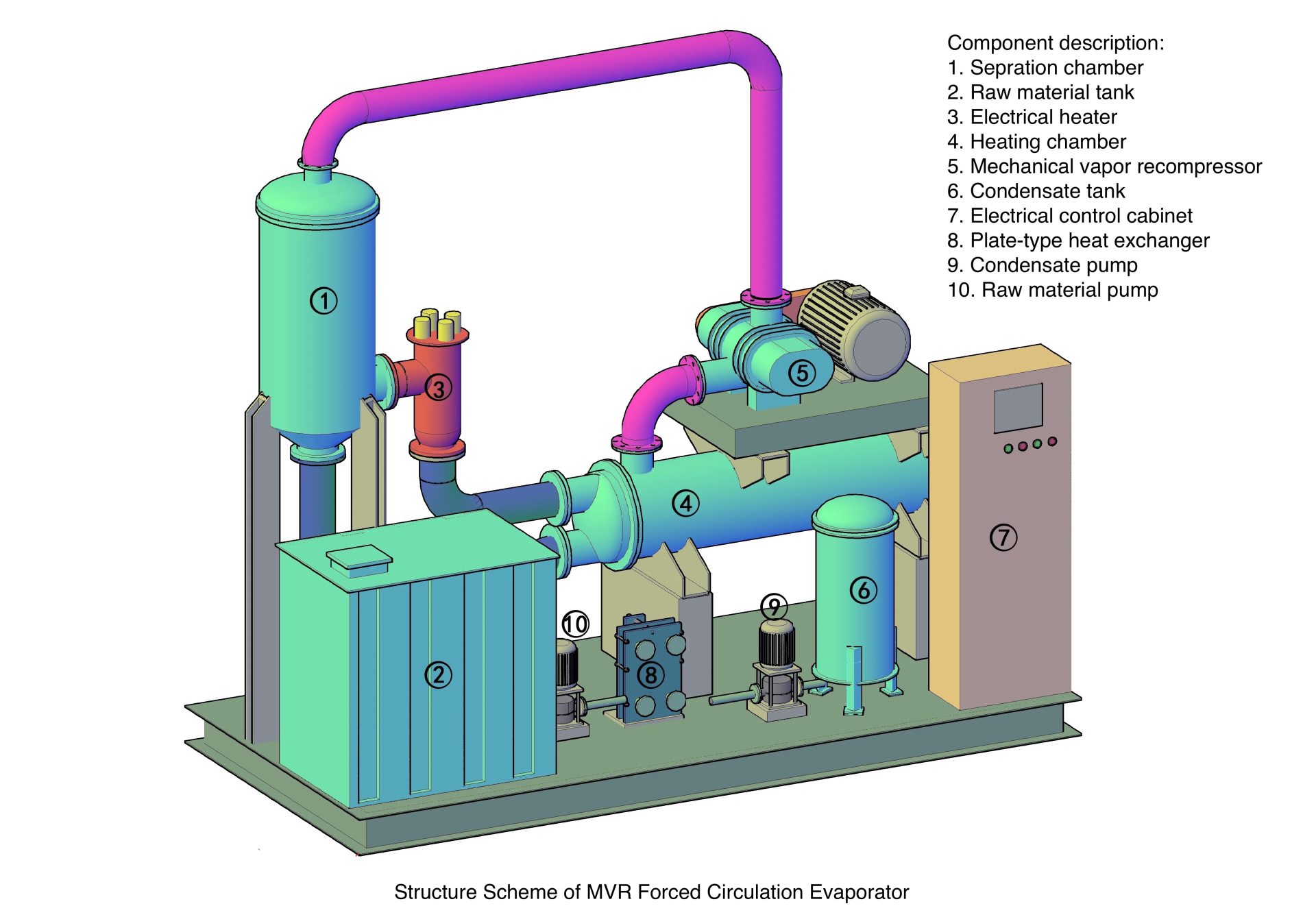
Common types of vapor compressors used in Mechanical Vapor Recompression (MVR) systems include Roots compressors, axial flow compressors, centrifugal fans, and centrifugal compressors. Among these, centrifugal compressors are typically dynamic compressors, characterized by high capacity and relatively low pressure rise per stage. They are generally suitable for large-scale evaporation systems.
In contrast, Roots compressors are mainly applied in small to medium evaporation capacity conditions.
Working Principle of Roots Compressor
The Roots compressor operates on the same principle as a conventional Roots-type blower and belongs to the category of positive displacement compressors. The gas handling capacity is directly proportional to the rotational speed.
A small clearance is maintained between the impeller surfaces and the casing, as well as between the rotors themselves. Driven by synchronized timing gears, the vapor is transported from the inlet along the inner wall of the casing to the outlet side.
In MVR applications, water vapor is compressed instead of air, achieving the required pressure and temperature increase for heat recovery.
Performance Characteristics and Application Range
The Roots compressor can typically provide an effective temperature rise of up to 25°C (for water vapor). It is therefore suitable for processes with:
• Relatively small evaporation capacity
• Relatively high boiling point elevation (BPE)
Typical application limits:
• Evaporation capacity: ≤ 8 t/h
• Boiling point elevation: ≤ 25°C
For systems exceeding these conditions, centrifugal compressors are generally preferred due to their higher efficiency and better performance at large capacities.
Summary
Roots compressors are a reliable and cost-effective solution for small-scale MVR systems, offering stable operation and simple structure, making them widely used in low-capacity evaporation and crystallization applications.
Contact Us
Reach out to an optimized proposal