• Home
  • About Us
  • Products
    • MVR Evaporator
    • MEE Evaporator
    • Distillation & Concentration Unit
    • Complete Equipment
  • Featured Project
    • Chemical Industry
    • Lithium Battery Industry
    • Wastewater Treatment
    • Food & Pharmaceutical
  • Blog
  • Contact
  • Download

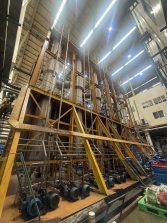
Four-Effect Mixed-Flow Evaporator for a DDGS Production Project

Home Featured Project Food & Pharmaceutical Four-Effect Mixed-Flow Evaporator for a DDGS Production Project

Four-Effect Mixed-Flow Evaporator for a DDGS Production Project

This featured project presents a four-effect mixed-flow falling film evaporation system designed for thin stillage concentration in a corn ethanol DDGS production plant. 

The evaporator integrates multi-effect evaporation, waste heat recovery from the tube bundle dryer, and TVR (Thermal Vapor Recompression) to maximize thermal energy utilization and reduce fresh steam consumption.

A mixed-flow arrangement with first-effect syrup discharge helps maintain suitable fluidity of the concentrated material, reducing the risk of fouling and tube blockage while ensuring stable continuous operation.

Feed capacity:13,500 kg/h of thin stillage;

Feed concentration: approx. 3.5%;

Output concentration: approx. 30%. 
Food & Pharmaceutical2026-08-31e22 Tags: evaporation

Description

Project Overview

This featured project involves a four-effect mixed-flow falling film evaporation system supplied for a DDGS production line in a corn ethanol plant.

In the DDGS production process, whole stillage from the ethanol distillation section is separated by a decanter centrifuge into wet cake and thin stillage. The thin stillage, containing approximately 3.5% solids, needs to be concentrated before being sent to the downstream drying section.

For this project, a four-effect mixed-flow falling film evaporator integrated with waste heat recovery and TVR (Thermal Vapor Recompression) was designed to concentrate the thin stillage from approximately 3.5% to 30% solid content.

A major focus of the project was energy efficiency. Waste heat from the downstream tube bundle dryer is recovered and reused as a heat source for evaporation, while TVR further recovers secondary vapor. This integrated configuration significantly improves thermal energy utilization and reduces the consumption for fresh steam.

Project Requirements

The main requirements for the evaporation section included:

Item

Project Requirement

Application

DDGS production in corn ethanol plant

Feed Material

Thin stillage @ 13,500kg/h

Feed Concentration

Approx. 3.5% solids

Final Concentration

Approx. 30% solids

Evaporation Configuration

Four-effect mixed-flow

Evaporator Type

Falling film evaporator

Energy-Saving Technology

Waste heat recovery from subsequence tube bundle dryer + TVR

Downstream Process

Mixing with wet cake + tube bundle drying

Operation

Continuous

The evaporation system needed not only to achieve the required concentration but also to work closely with the downstream tube bundle drying system to minimize the overall energy consumption of the DDGS production line.

Process Description

Whole stillage from the distillation section is first separated by a decanter centrifuge. The solid fraction is discharged as wet cake, while the liquid fraction forms thin stillage with a solids concentration of approximately 3.5%.

The thin stillage is fed continuously to the four-effect evaporation system and concentrated to approximately 30% solids.

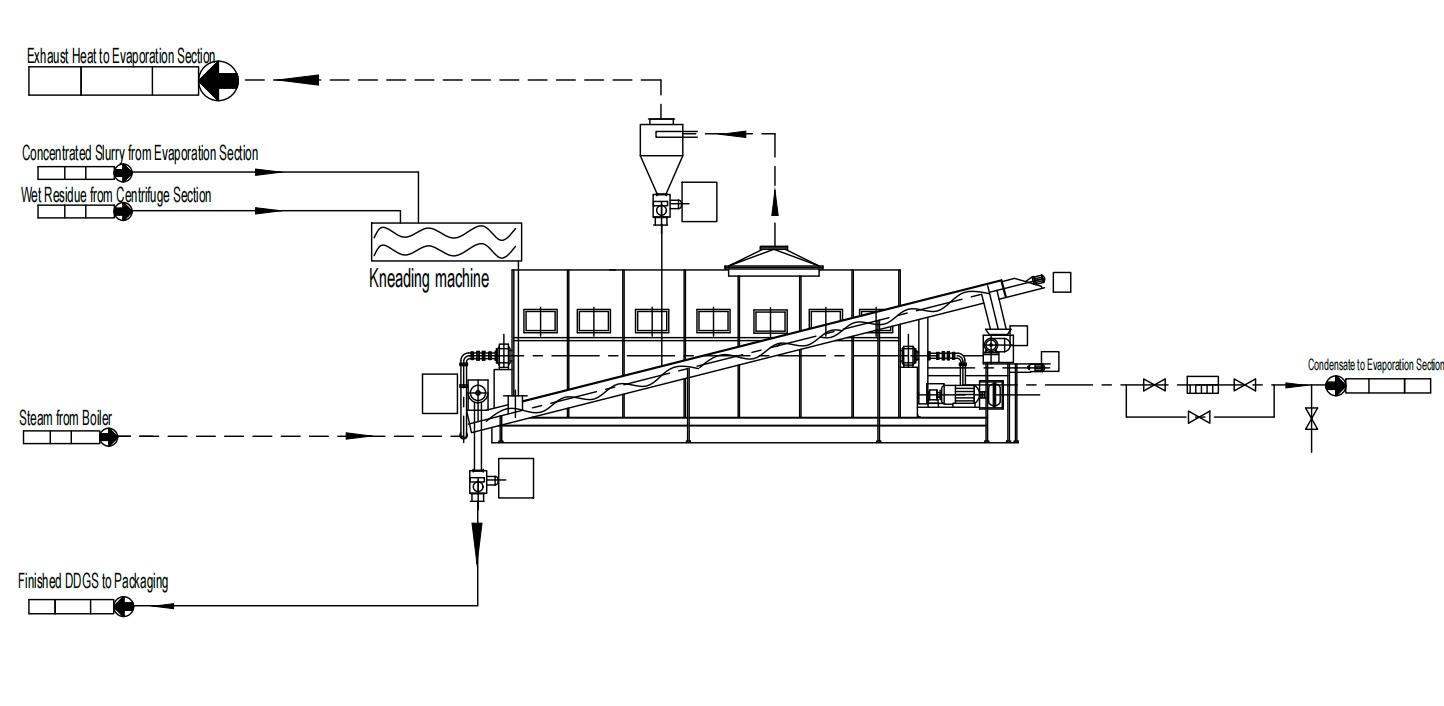
The concentrated syrup is then uniformly mixed with the wet cake and sent to the tube bundle dryer for final drying.

By removing a large amount of water in the evaporation section, the moisture load entering the tube bundle dryer is significantly reduced.

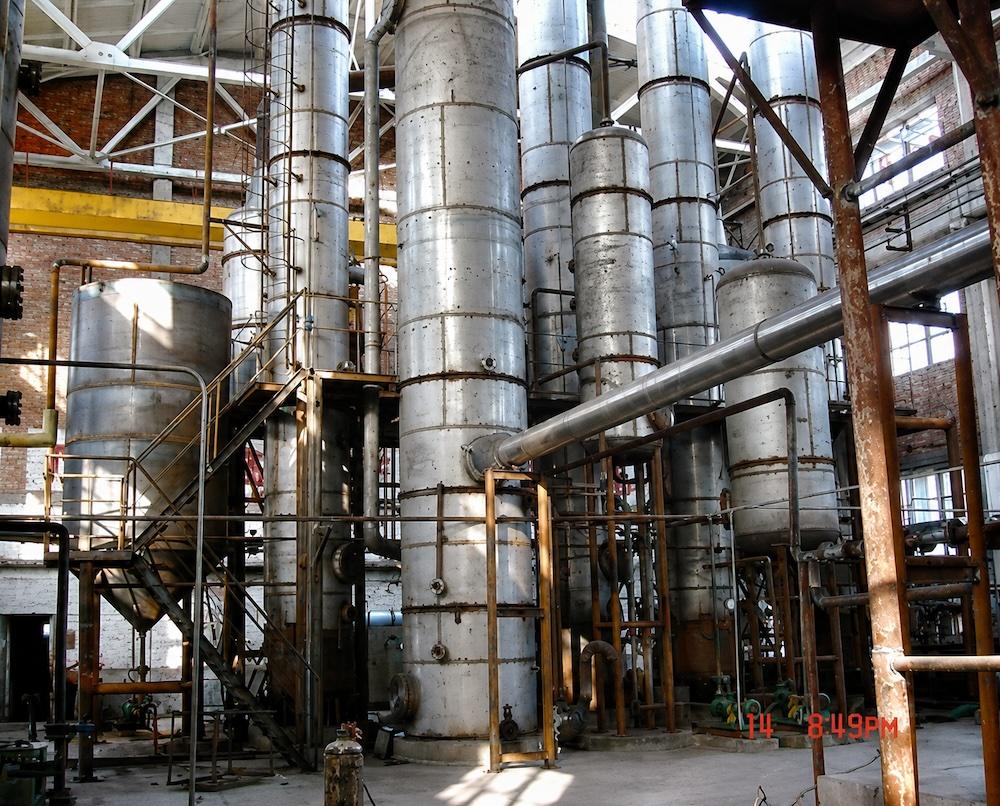
Four-Effect Mixed-Flow Evaporator

For this project, a four-effect mixed-flow arrangement was selected according to the concentration and flow characteristics of the thin stillage.

As the thin stillage is concentrated from approximately 3.5% to 30%, its viscosity increases and fluidity gradually decreases. The mixed-flow configuration allows the material to pass through the four effects under more suitable temperature and concentration conditions.

One of the key design features is that the final concentrated syrup is discharged from the first effect.

The relatively higher temperature of the first effect helps maintain suitable fluidity of the concentrated syrup. This is particularly important as organic matter and non-volatile components become concentrated, increasing viscosity and the tendency for deposition.

The arrangement therefore helps reduce the risk of fouling and tube blockage while ensuring stable transfer of the concentrated syrup to the downstream mixing section.

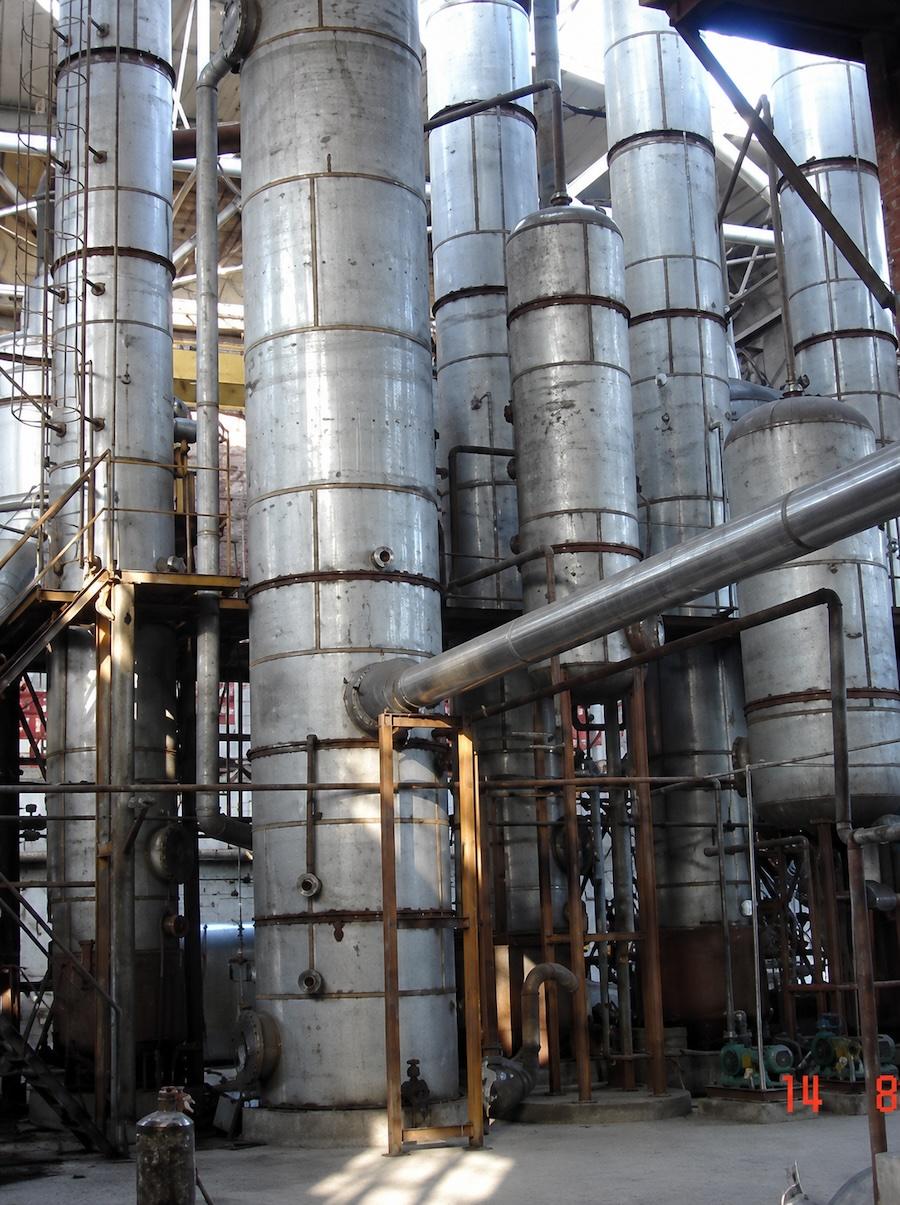
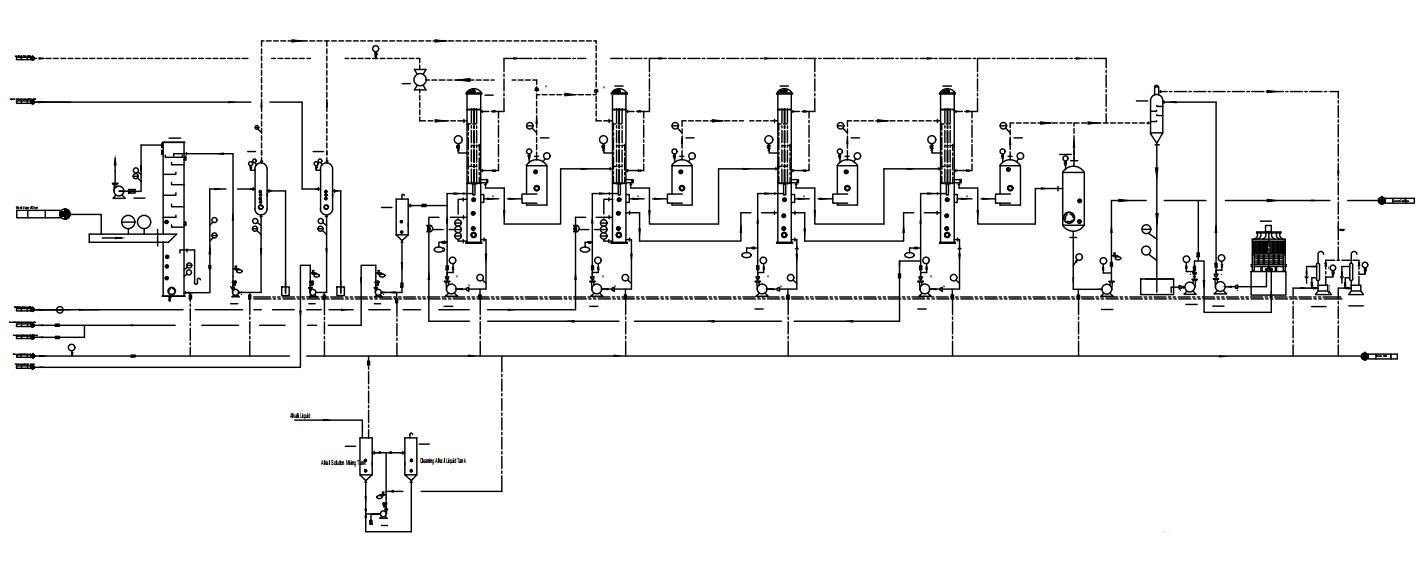
Four-effect Mixed-flow Evaporator system

Waste Heat Recovery from the Tube Bundle Dryer

One of the main features of this project is the utilization of waste heat from the downstream tube bundle dryer. Two waste heat sources are recovered and reused in the evaporation system.

Hot condensate from the tube bundle dryer is sent to a flash tank, where secondary steam is generated and reused as a heat source for evaporation.

Meanwhile, hot exhaust gas from the tube bundle dryer enters an absorption tower, where its heat is recovered by circulating water. The heated circulating water is then sent to a flash tank to generate secondary steam for the evaporation system.

By recovering heat from both the dryer condensate and exhaust gas, thermal energy from the drying section is reused in the evaporation process instead of being directly discharged. This improves the overall energy efficiency of the system and reduces external fresh steam consumption.

Waste heat recovery from tube bundle dryer

Project Summary

This four-effect mixed-flow falling film evaporator demonstrates the integration of multiple energy-saving technologies, including multi-effect evaporation, exhaust heat recovery, and TVR, in a DDGS production plant.

The evaporation system concentrates thin stillage from approximately 3.5% to 30% solids. The concentrated syrup is then uniformly mixed with wet cake and sent to the tube bundle dryer for final DDGS production.

By adopting a mixed-flow arrangement with first-effect syrup discharge, the system maintains suitable fluidity of the highly concentrated material and helps reduce the risk of fouling and tube blockage. Meanwhile, the combination of exhaust heat recovery and TVR maximizes thermal energy reuse and reduces fresh steam consumption.

This project provides a practical reference for energy-efficient thin stillage evaporation in corn ethanol DDGS production plant.

Inquiry Us


Related Products

Single-Effect Falling Film Evaporator for Low-Temperature Molasses Concentration

2026-08-21e22

Five-effect Falling Film Evaporator for HFCS Concentration

2026-04-19e22
4-effect TVR evaporator for instant coffee production

4-Effect TVR Evaporator for Instant Coffee Production

2026-03-22e22

Product Categories

  • Product
    • MVR Evaporator
    • MEE Evaporator
    • Distillation & Concentration Unit
    • Complete Equipment
  • Featured Project
    • Lithium Battery Industry
    • Wastewater Treatment
    • Chemical Industry
    • Food & Pharmaceutical

Product Tags

CaCl2 concentrator crystallization Distillation evaporation Lithium Battery Industry MEE MVR wastewater treatment

Latest Post

  • Calcium Chloride Plant in Algeria Reaches Key Commissioning Milestone
    2026-08-12
  • Comparison of DTB, Oslo, and FC Crystallizers: Principles, Characteristics, and Applications
    2026-06-05
  • Achieving Low Residual Moisture Content in Industrial Salt Crystallization Processes
    2026-05-27

Email Newsletters

Welcome to subscribe email newsletter to us, get the lastest products and news information from us!

Contact Us

+86-135 875 13702

info@enchem-tech.com

info@enchem-tech.com

Zengdu District, Suizhou City, Hubei Province, China

Mobile Website

Copyright © 2012-2017 Wenzhou Enchem Technology Co.,Ltd. All Rights Reserved Design by enchem-tech.com