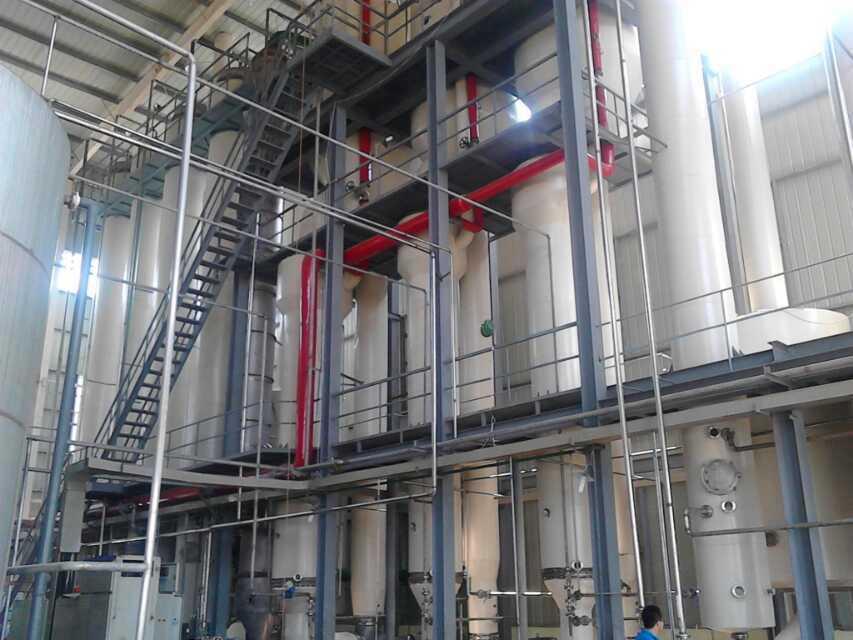
Principle of Falling Film Evaporator
A falling film evaporator is a highly efficient evaporation system widely used in chemical, pharmaceutical, food, and environmental industries for the concentration of heat-sensitive materials and solutions.
The main difference between a falling film evaporator and a rising film evaporator lies in the direction of liquid flow. In a rising film evaporator, the liquid moves upward through the heating tubes driven by vapor flow, while in a falling film evaporator, the feed liquid flows downward along the inner wall of the heating tubes under the effect of gravity.
This unique flow pattern enables the formation of a thin and uniform liquid film on the heating surface, resulting in excellent heat transfer performance, short residence time, and high evaporation efficiency.
Working Principle
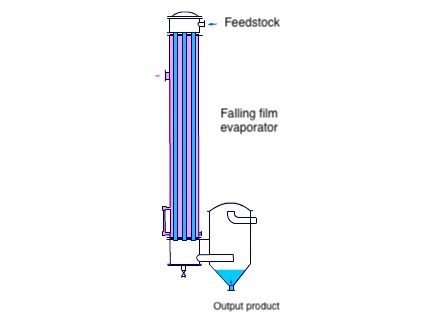
In a falling film evaporator, the feed liquid is evenly distributed through a specially designed liquid distributor and enters the top of the heating tubes. The liquid then flows downward as a thin film along the inner tube walls while being heated by steam or another heating medium outside the tubes.
During the downward flow process, part of the solvent evaporates continuously. The generated vapor flows downward together with the liquid and is separated from the concentrated solution in the separation chamber.
The key factors affecting the performance of a falling film evaporator include:
• Uniform liquid distribution inside each heating tube;
• Stable and continuous film formation on the heating surface;
• Proper control of feed flow rate, heating temperature, and vacuum conditions.
A well-designed liquid distribution system ensures complete wetting of the heating surface and prevents dry spots, improving heat transfer efficiency and operational stability.
Advantages of Falling Film Evaporator
1. High Heat Transfer Efficiency
The liquid flows as a thin film along the heating surface, significantly reducing thermal resistance and enhancing heat transfer efficiency. Compared with traditional evaporation technologies, falling film evaporators can achieve higher evaporation capacity with a more compact design.
2. Short Residence Time and Low Thermal Impact
Due to the thin liquid film and high evaporation rate, the residence time of the material inside the evaporator is minimized. This makes falling film evaporators particularly suitable for heat-sensitive products that require gentle evaporation conditions.
3. Energy-Efficient Operation
The efficient heat transfer characteristics allow falling film evaporators to operate with lower temperature differences, reducing energy consumption and improving overall system efficiency.
4. Stable and Flexible Operation
With optimized liquid distribution and advanced automatic control systems, falling film evaporators can maintain stable operation under varying feed conditions, ensuring consistent product quality.
Optimization of Falling Film Evaporator Performance
The core of falling film evaporation technology is the formation of a stable and uniform liquid film. Therefore, improving evaporation performance mainly focuses on optimizing liquid distribution and operating conditions.
The main improvement measures include:
1. Advanced Liquid Distribution Design
The liquid distributor is one of the most important components of a falling film evaporator. An optimized distributor design ensures uniform flow distribution among all heating tubes, improves film coverage, and maximizes heat transfer efficiency.
2. Intelligent Automatic Control System
Falling film evaporators require precise control of operating parameters, including feed flow rate, steam pressure, vacuum level, and temperature.
An advanced automatic control system helps maintain optimal operating conditions, improves evaporation efficiency, reduces energy consumption, and enhances equipment reliability.
Through optimized design, precise control, and advanced manufacturing technology, falling film evaporators provide an efficient and reliable solution for industrial concentration processes.
Contact US
Reach out to an optimized proposal