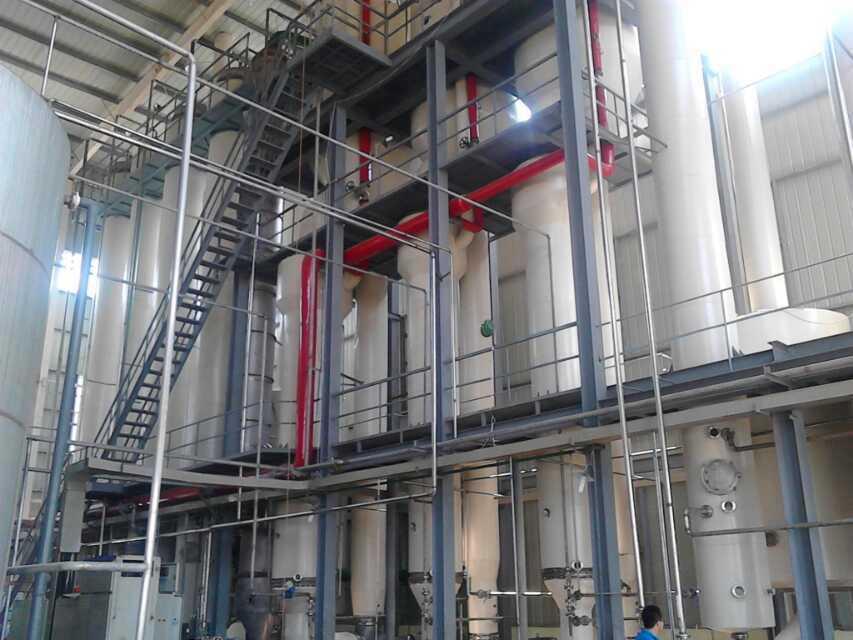
MVR Evaporator Overview
MVR (Mechanical Vapor Recompression) evaporator is a high-efficiency, energy-saving evaporation system that recovers and reuses the latent heat contained in secondary vapor through mechanical compression.
During the evaporation process, secondary vapor generated from the feed solution is compressed by a mechanical vapor compressor. This compression increases the vapor’s pressure, temperature, and enthalpy, enabling it to be reused as a heating medium in the evaporator’s heat exchanger. As the compressed vapor condenses, it releases its latent heat to sustain the evaporation process, forming a highly efficient closed-loop energy recovery cycle.
By continuously recycling the latent heat of vaporization, an MVR evaporator dramatically reduces the demand for external steam. After system startup, only a small amount of live steam is typically required for startup and occasional supplemental heating, resulting in significantly lower operating costs and carbon emissions.
Multi-Effect Evaporator (MEE) Overview
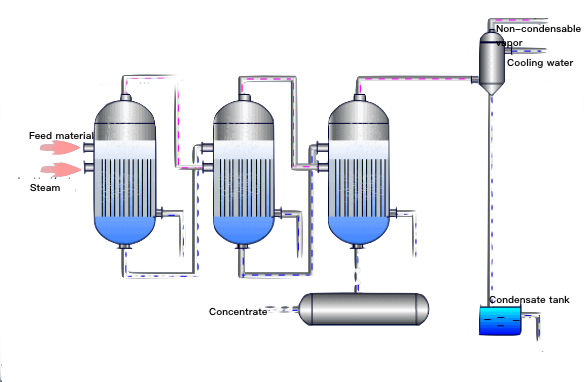
A Multi-Effect Evaporator (MEE) is an evaporation system consisting of multiple evaporator stages, known as “effects”, connected in series. The secondary vapor generated in one effect is utilized as the heating medium for the subsequent effect, allowing the latent heat to be reused multiple times throughout the system.
This cascading utilization of thermal energy substantially reduces fresh steam consumption compared with a single-effect evaporator, making MEE one of the most widely adopted energy-saving evaporation technologies. Among the various configurations available, the Triple-effect Evaporator is the most commonly used in industrial applications due to its balanced performance, investment cost, and energy efficiency.
MVR vs. MEE: Operating Cost Comparison
The primary energy source for an MVR evaporator is electricity, which drives the mechanical vapor compressor. The compressor upgrades the secondary vapor by increasing its pressure and temperature, allowing it to be continuously recycled as the heating medium. Consequently, fresh steam is required only during system startup and, in some cases, as a small supplemental heat source during operation.
In contrast, a Multi-Effect Evaporator (MEE) relies primarily on live steam as its heat source. Although the latent heat of secondary vapor is recovered from one effect to the next, a continuous supply of fresh steam is still necessary to maintain stable evaporation throughout the system.
From an energy-efficiency perspective, MVR generally offers lower operating costs than MEE, particularly in large-scale, continuous production where electricity is relatively inexpensive compared with steam generation. However, the economic advantage depends on local utility prices, operating capacity, and process conditions.
It is important to note that MVR and MEE are not direct substitutes. The selection of the most appropriate technology should be based on a comprehensive evaluation of material characteristics, boiling point elevation (BPE), heat sensitivity, fouling tendency, production capacity, utility availability, and overall project economics. In many industrial applications, hybrid MVR–MEE systems are also employed to achieve the optimum balance between capital investment and operating cost.
The table below provides a general comparison of the operating costs between an MVR evaporator and a conventional triple-effect evaporator. The values are intended for reference only, as actual operating costs will vary depending on process conditions, plant capacity, and local electricity and steam prices.
|
Item |
Triple-effect evaporator | MVR Evaporator | |
|
Evaporation capacity:16ton/hr |
|||
|
Operating mode |
Floor area (m) | 12 *18 | 6 *12 |
|
Energy sources |
Fresh steam |
IEI |
|
| Material input/output | Continuous |
Continuous |
|
|
Operating cost |
Steam (t/h) | 6.6 | 0.9 |
|
Power consumption (kwh) |
~240 |
~923 |
|
| Circulating water (m3/h) | 600 |
100 |
|
| Note: The above power consumption includes the energy used by the centrifuge, thickener agitators, and other auxiliary equipment. | |||
Contact Us
Feel free to contact us for customized solutions and competitive offers in evaporation and crystallization systems.