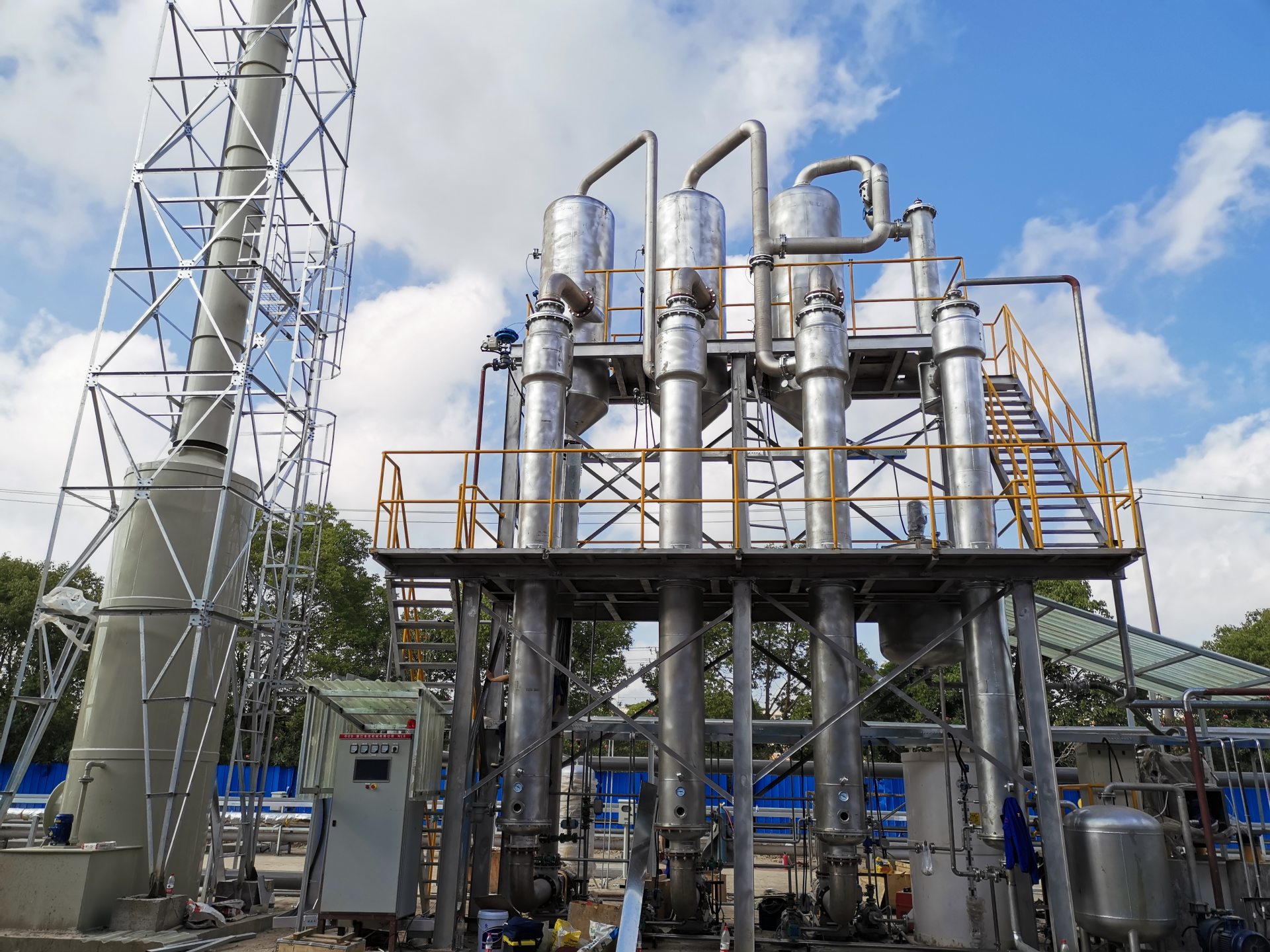
The total cost of an evaporator consists of two components: capital investment and operating cost. While the equipment investment is a one-time expenditure, the operating cost continues throughout the service life of the plant and usually represents the largest portion of the total lifecycle cost.
The operating cost of an evaporator system mainly includes steam consumption and electricity consumption. Since steam is typically the primary energy source, most energy-saving measures focus on reducing steam consumption. The following are the most common methods for improving the energy efficiency of an evaporator system.
Adopt a Multiple-Effect Evaporation (MEE) System
A multiple-effect evaporator reuses the secondary vapor generated in one effect as the heating medium for the next effect, significantly reducing steam consumption. In general, each additional effect further lowers energy consumption but increases equipment investment and system complexity.
For high-salinity wastewater applications, triple-effect evaporation is the most common configuration, while four-effect systems are generally considered the practical upper limit due to scaling and operational considerations.
Apply Thermal Vapor Recompression (TVR)
A Thermal Vapor Recompression (TVR) system uses a steam ejector to recover part of the secondary vapor and mix it with fresh steam, thereby reducing live steam consumption. The energy-saving benefit of a TVR system is roughly equivalent to adding one extra evaporation effect.
For example, a double-effect evaporator equipped with TVR typically achieves steam consumption comparable to that of a conventional triple-effect evaporator.
Use Mechanical Vapor Recompression (MVR)
Mechanical Vapor Recompression (MVR) technology compresses the secondary vapor using an electrically driven compressor or blower, increasing its temperature and allowing it to be reused as the heating medium.
Compared with conventional multiple-effect evaporation, MVR dramatically reduces steam consumption and can achieve an energy efficiency equivalent to that of a ten-effect evaporator, making it one of the most energy-efficient evaporation technologies available.
Improve Thermal Insulation
Proper insulation of evaporator bodies, piping, valves, and other high-temperature equipment minimizes heat loss to the environment, improving thermal efficiency and reducing overall energy consumption.
Recover Condensate Heat
Both the sensible heat and latent heat of condensate can be effectively recovered.
• Sensible heat recovery: Install feed preheaters to use hot condensate for preheating the incoming feed solution, thereby reducing the required heating duty.
• Latent heat recovery: Incorporate a flash steam recovery system to utilize the flash vapor generated from high-temperature condensate for additional process heating.
Conclusion
There is no single evaporator configuration that is optimal for every application. The most cost-effective solution should be selected based on the feed characteristics, required evaporation capacity, available utilities, local energy prices, and project budget.
A well-designed evaporator system balances capital investment, operating cost, energy efficiency, and long-term reliability to achieve the lowest total lifecycle cost.
Contact Us
Reach out to an optimized solution