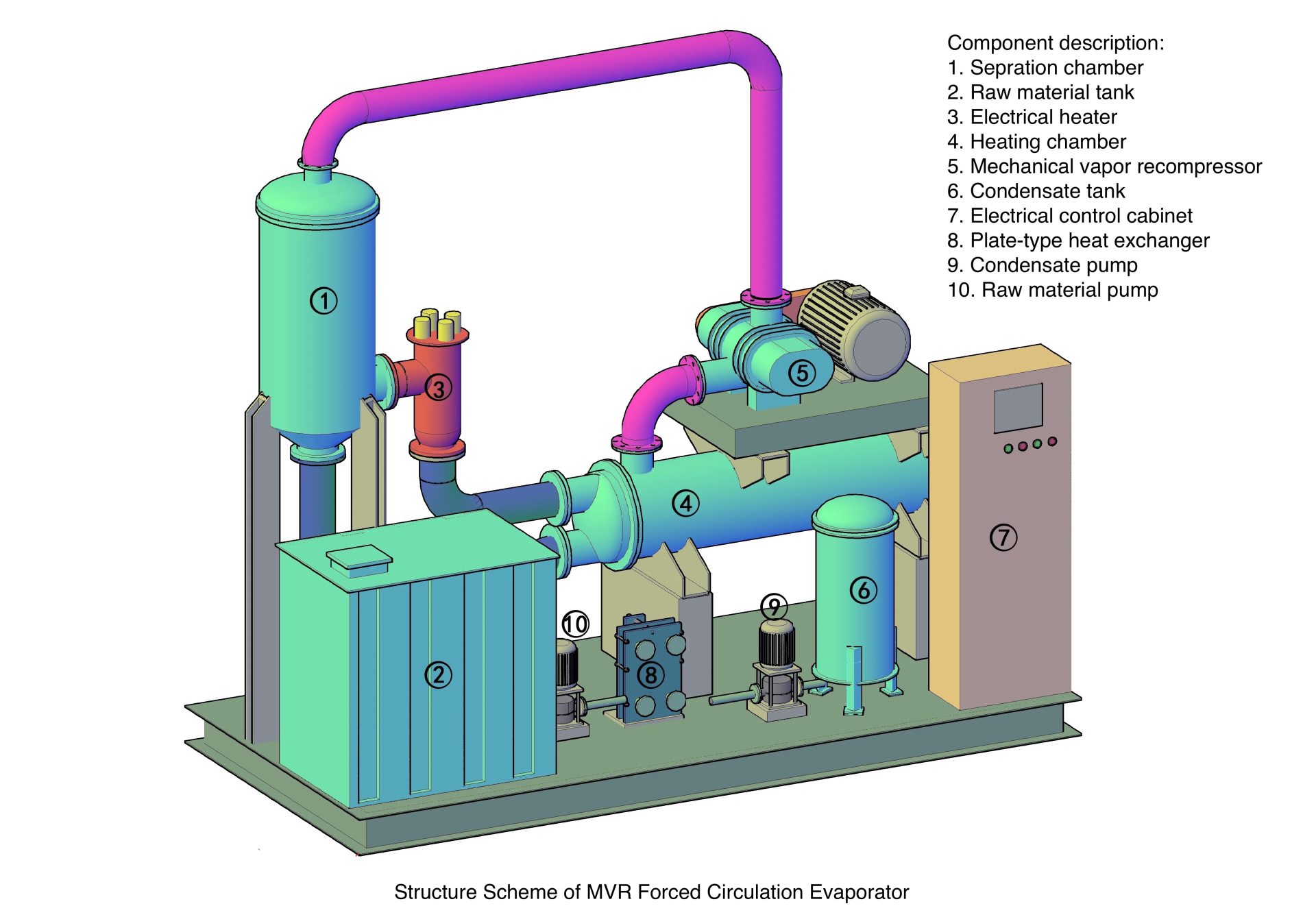
Technical background of MVR evaporator
Evaporation, distillation, evaporation-crystallization, and evaporation-drying systems are inheretly energy-intensive. Energy consumption represents a significant portion of the operating costs for these system. Therefore, reducing and optimizing specific energy consumption is one of the most effective ways to minimize overall operating expenses.
To improve energy efficiency, three main technologies are commonly employed. Depending on the process requirements, these technologies may be applied individually or in combination.
• Multiple-Effect Evaporation (MEE)
Multiple-effect evaporation reuses the secondary vapor generated in one effect as the heating medium for the suesequent effect. By cascading the latent heat through multiple stages, steam consumption is significantly reduced.
• Thermal Vapor Recompression (TVR)
TVR systems utilize steam ejectors to recompress a portion of the secondary vapor. The recompressed vapor is mixed with fresh steam, increasing its pressure and temperature so that it can be reused as the heating medium.
• Mechanical Vapor Recompression (MVR)
MVR systems mechanically compress the secondary vapor generated during evaporation, increasing its pressure, temperature and enthalpy. The compressed vapor is then reused as the heating medium in the evaporator, replacing most or all the external steam required for the process. 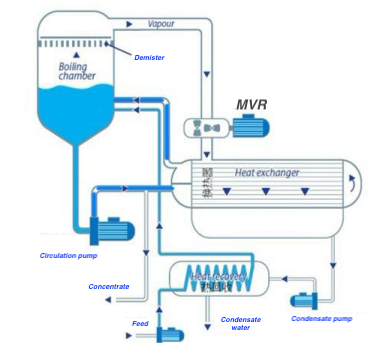
Among these technologies, MVR technology offers the lowest specific energy consumption and is widely recognized as the most energy-efficient solution for industrial evaporation applications. By utilizing electrical energy to recover and recycle the latent heat of the secondary steam, MVR systems dramatically reduce external steam demand while providing a sustainable and cost-effective evaporation process.
MVR: A High-Efficiency, Energy-Saving Evaporation Technology
Mechanical Vapor Recompression (MVR technology) is an advanced evaporation technology that recovers and reuses the latent heat contained in the secondary vapor generated during evaporation. By recycling this thermal energy, MVR greatly reduces the consumption of fresh steam and significantly lowers the overall energy costs.
During operation, the low-temperature secondary vapor produced by the evaporator is drawn into a mechanical compressor. The compressor increases the vapor’s pressure, temperature, and enthalpy, converting it into a high-grade heating medium. The compressed vapor is then returned to the heating chamber of the evaporator, where it supplies the thermal energy required to continue the evaporation process.
As the compressed vapor releases its latent heat, it condenses into condensate, while the feed solution continues to evaporate and generate new secondary vapor. This closed-loop cycle enables the latent heat of the vapor to be continuously recycled, resulting in exceptionally high thermal efficiency.
Compared with conventional evaporation systems, MVR requires only a small amount of start-up steam and minimal supplemental steam during operation. In terms of steam economy, an MVR evaporator can achieve an equivalent performance comparable to that of a conventional 20- to 30-effect evaporator, while offering a much simpler process configuration and a smaller installation footprint.
Applications of MVR Technology
Mechanical Vapor Recompression (MVR) technology is widely used in industries requiring continuous, energy-efficient evaporation, concentration, crystallization, and solvent recovery. Owing to its low operating costs, compact design, and high thermal efficiency, MVR has become the preferred solution for numerous industrial and environmental applications.
• Chemical Industry
- Concentration of chemical solutions such as sodium sulfate, ammonium chloride, sodium chloride, and phosphoric acid
- Recovery of valuable chemicals and process solvents
- Evaporation and Crystallization of inorganic salts from brine and process liquors
• Pharmaceutical Industry
- Concentration of pharmaceutical intermediates and APIs
- Treatment of high-COD pharmaceutical wastewater
- Low-temperature concentration of heat-sensitive compounds
• Food and Beverage Industry
- Concentration of juices, dairy products (e.g., whey, milk), tea extracts and liquid sweeteners
- Production of extracts, flavorings, and nutritional ingredients
- Concentration of starch processing liquors and fermentation products
• New Energy Materials
- Concentration and purification processes in the production of lithium carbonate, lithium hydroxide, and ternary cathode precursors
- Wastewater treatment in lithium iron phosphate (LFP) and nickel-cobalt-manganese (NCM) battery material production
- Recovery of valuable salts from process streams
• Metallurgical Industry
- Evaporation and crystallization of metal salt solutions
- Concentration of acidic and alkaline leachates
- Zero Liquid Discharge (ZLD) applications in hydrometallurgical process
• Environmental Protection
- Treatment of High-salinity industrial wastewater from chemical, textile and electroplating industries
- Landfill Leachate treatment
- Zero Liquid Discharge (ZLD) systems for industrial wastewater recycling and environmental compliance
• Bio-Fermentation and Biotechnology
- Concentration of fermentation broths
- Recovery of organic acids, amino acids, and enzymes
- Gentle processing of heat-sensitive biological materials
• Solvent Recovery
MVR technology is also widely applied in the recovery and purification of organic solvents, including ethanol, methanol, isopropanol, acetone and etc, used in chemical, pharmaceutical, and biotechnology processes. By recovering and recycling these valuable solvents, MVR systems not only reduce production costs but also minimize environmental emissions and improve process sustainability.
Contact US
Enchem is here to listen to your needs and provide sustainable solutions. Contact us to discover more